January 19, Monday – Explore Bangkok – Visit Grand Palace – Chaopraya River dinner cruise

Destination: Bangkok – Accommodations: Bizotel Premier Hotel

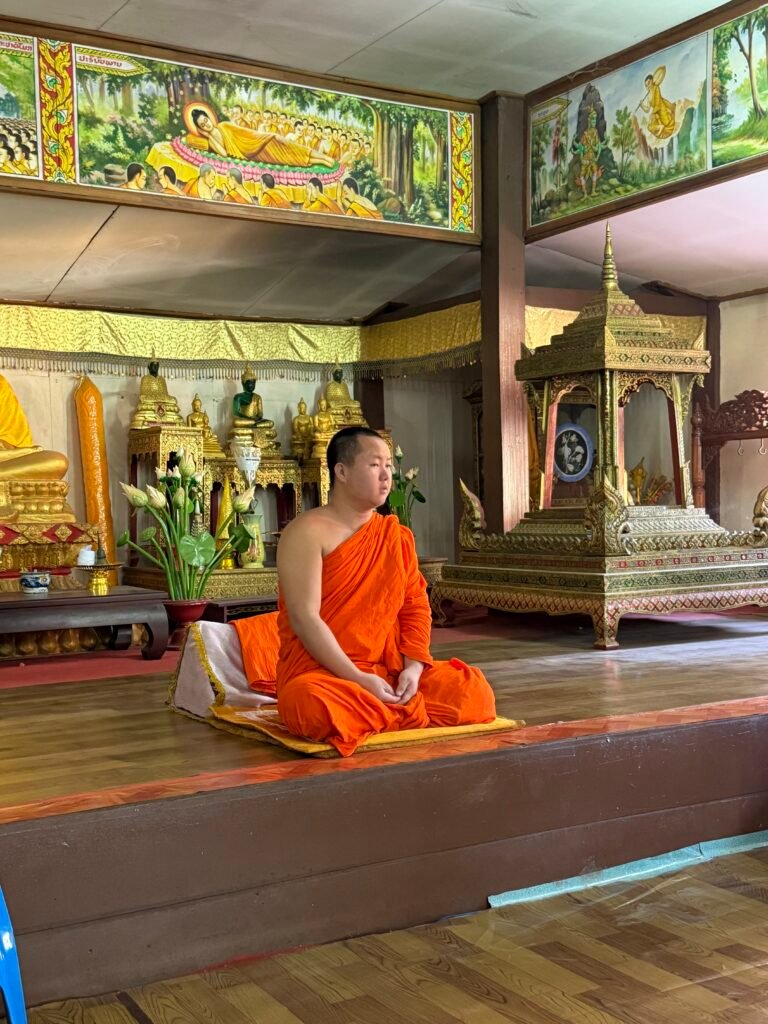
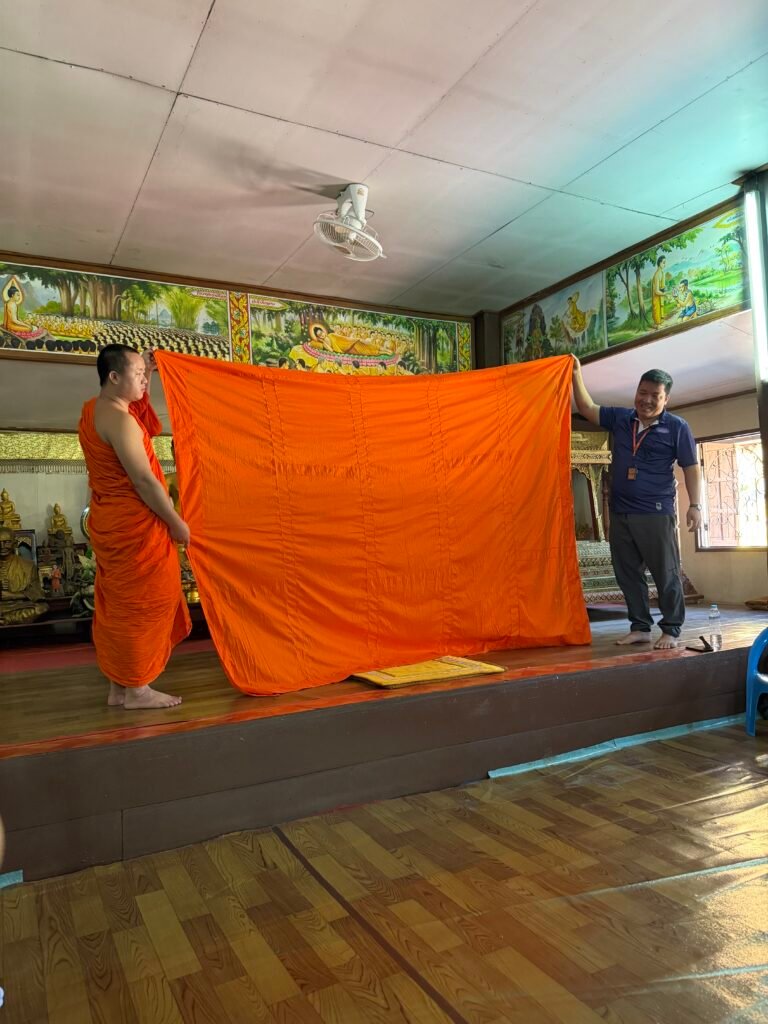
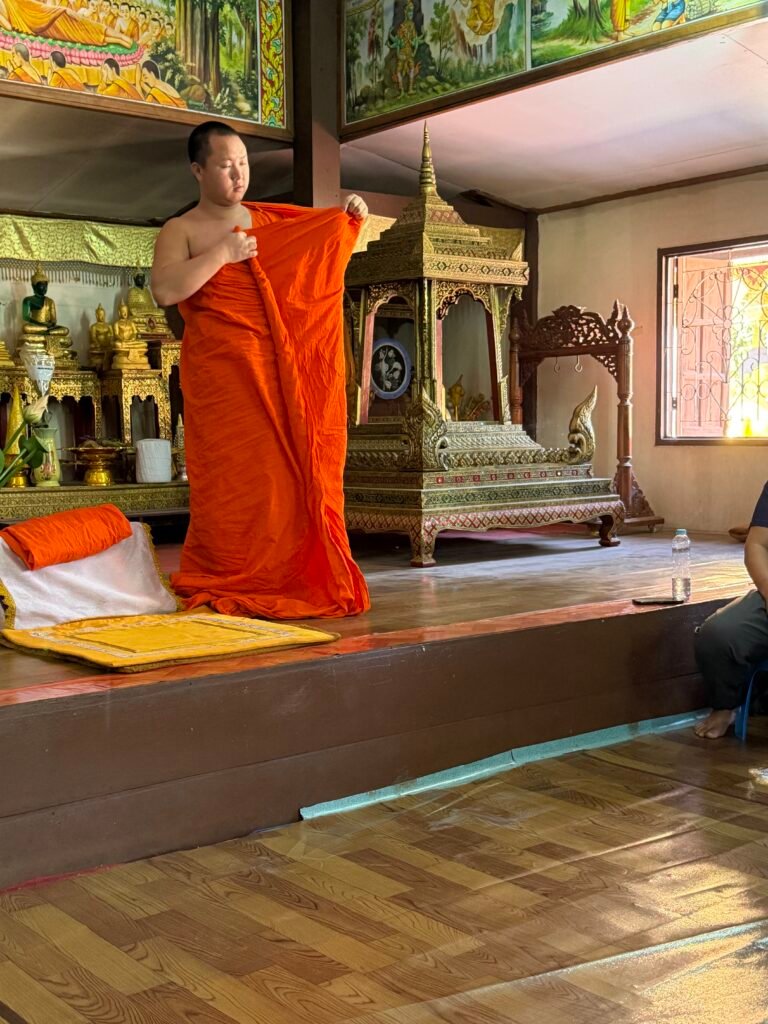
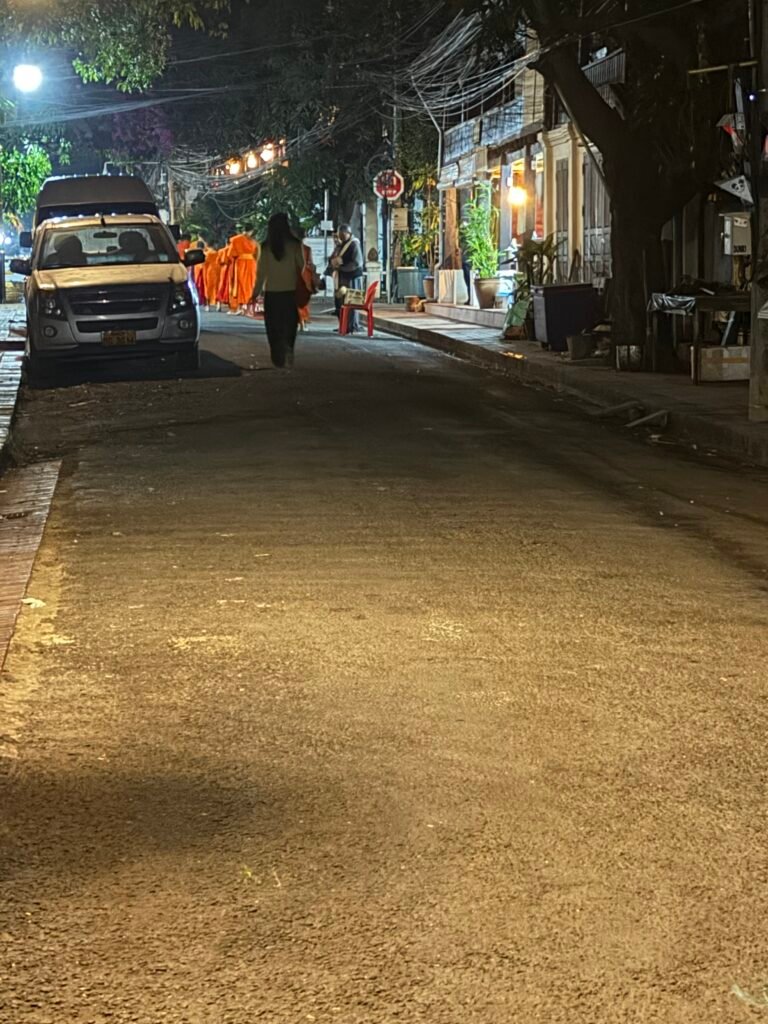
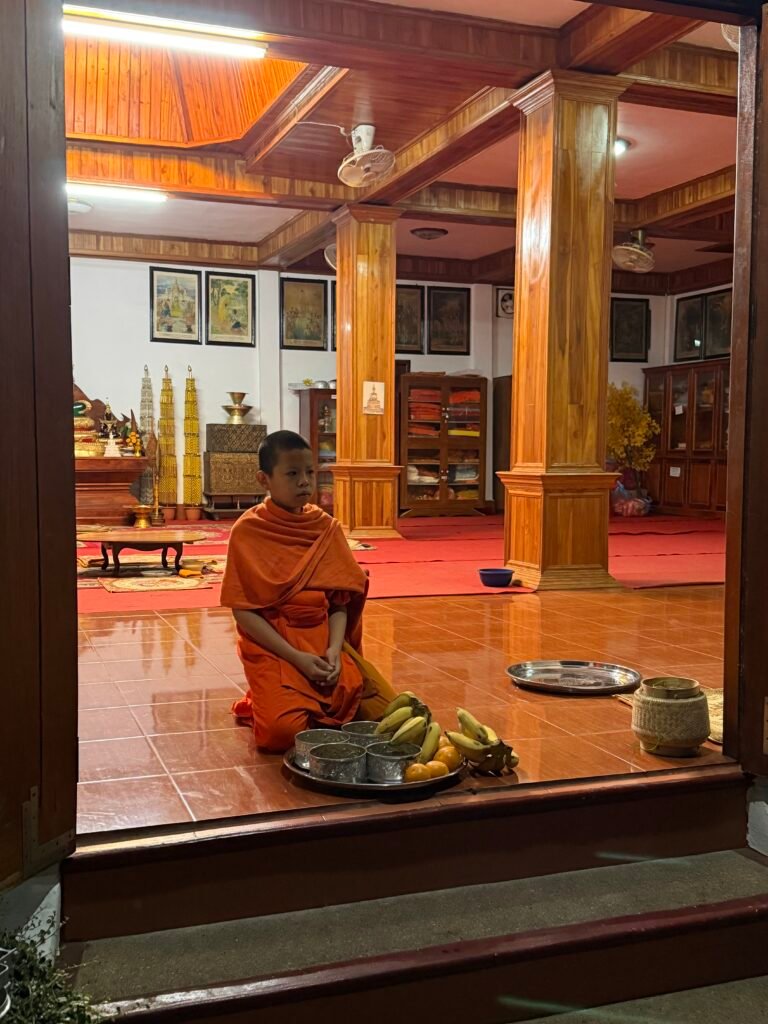
After breakfast, we boarded our bus to visit the Grand Palace. On the way, Are told us some information about monks. He said the monks that we see wearing white are not monks…nor are they men. They are nuns and they shave their heads just like the monks. Interestingly, Are said that Thai monks not only shave their heads, but they also shave their eyebrows and of course their beards. No facial hair at all.

Are also told us a beautiful philosophy about life that he had heard from a woman he spoke with one day. Life goes from B to D with C in the middle. B is birth. D is death. And C are the choices you make after B and before D.

We arrived at the Grand Palace. In 1782, the palace was constructed and the grounds cover more than 8 square miles. The palace had been the official residence of the Kings of Siam since 1782. Royalty no longer live in the palace, but it is used for official events.

Rather than being a single structure, the Grand Palace is made up of numerous buildings, halls, and pavilions set around open lawns, gardens and courtyards.

Within the grounds of the palace is the Wat Phra Kaew commonly known as the Temple of the Emerald Buddha, which is regarded as the most sacred Buddhist temple in Thailand.

The palace has a strict dress code. No sleeveless shirts and men and women have to cover their legs well below the knees. I was lucky once again to be allowed into the Temple of the Emerald Buddha with my booties covering my sneakers. The story behind the Emerald Buddha’s origin remains a mystery, but it is deeply revered by the Thai Royal Family as well as Thai citizens. We were not allowed to take photos inside the temple, but we could take a photo outside the door.

The Emerald Buddha is not made of emerald, but rather the emerald refers to the Buddha’s color. The Emerald Buddha is adorned with three sets of gold seasonal decorations: one for the summer and one for the rainy season, and a third for the winter or cool season. The decorations are changed each season by the King of Thailand, or a senior member of the royal family, which is quite a feat since they have to climb a huge ladder to get to the Buddha.

We walked around the beautiful grounds and took photos. It is truly a beautiful place. We also toured the Queen Sirikit Museum of Textiles which is on the premises. In 2003, Her Majesty Queen Sirikit the Queen Mother requested permission to use a then-vacant building on the grounds of the Grand Palace 
to house a new museum of textiles. A
building was granted for this purpose by His Majesty. The Queen Mother wanted to preserve Thailand’s textile arts for future generations.

The Royal Wardrobe of Her Majesty is on display in the museum and features the beautiful wardrobe she has worn through the decades. Sadly, the Queen Mother passed away a few months ago and Thailand is still mourning her passing and will continue to do so for a year.

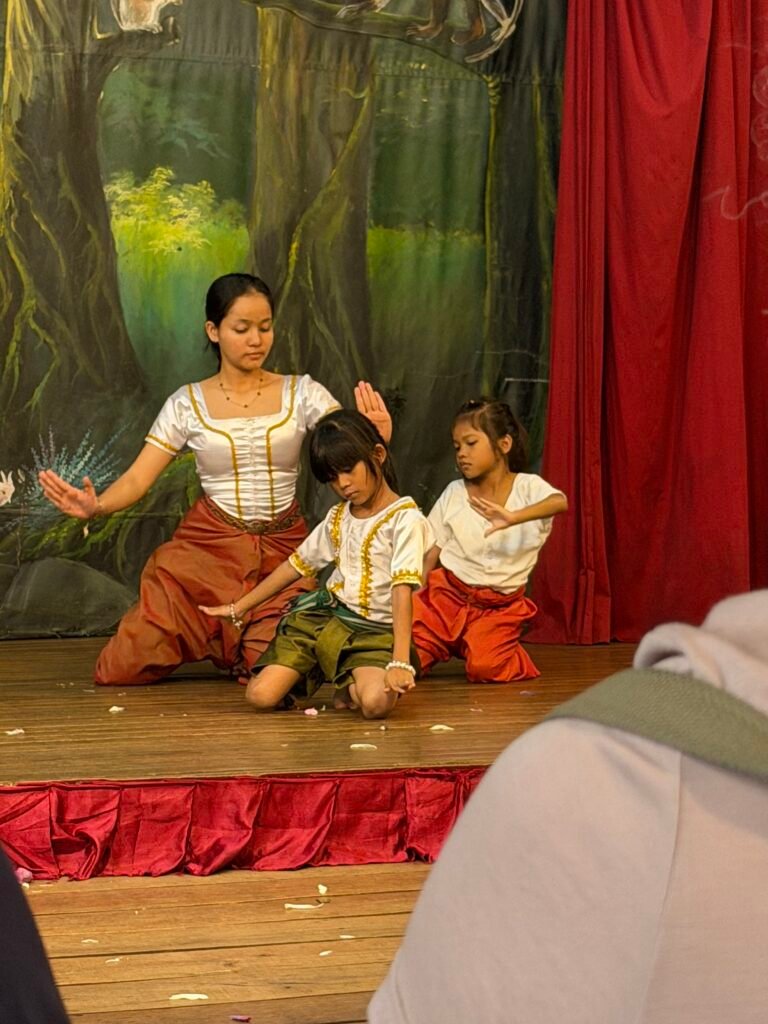
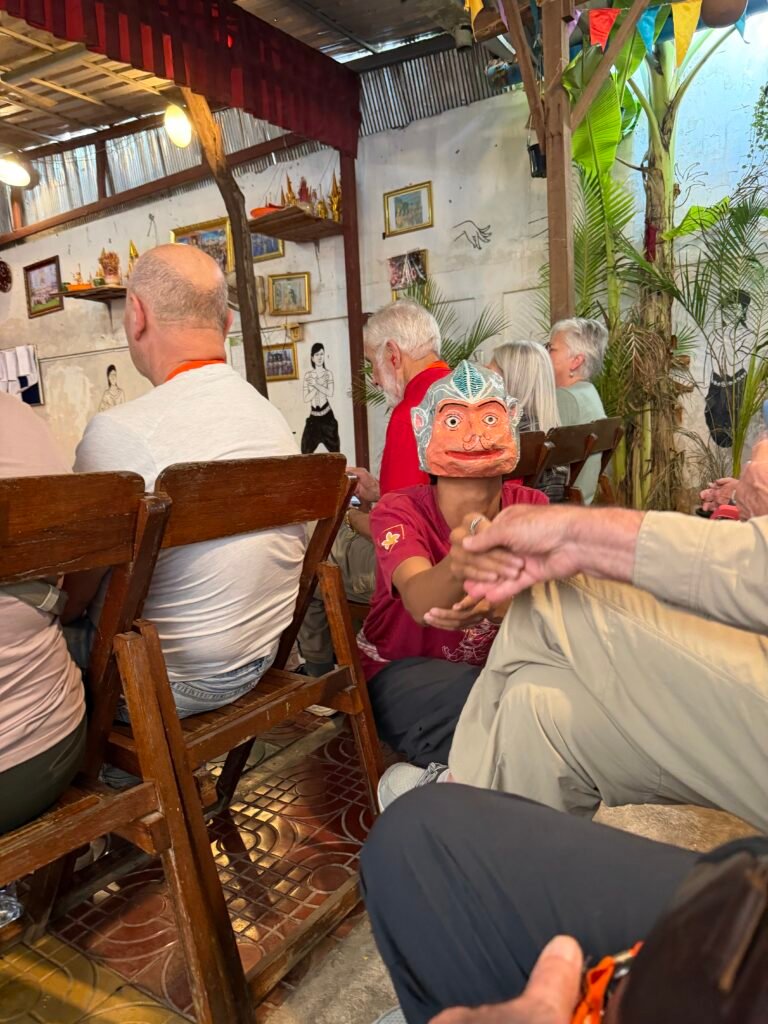
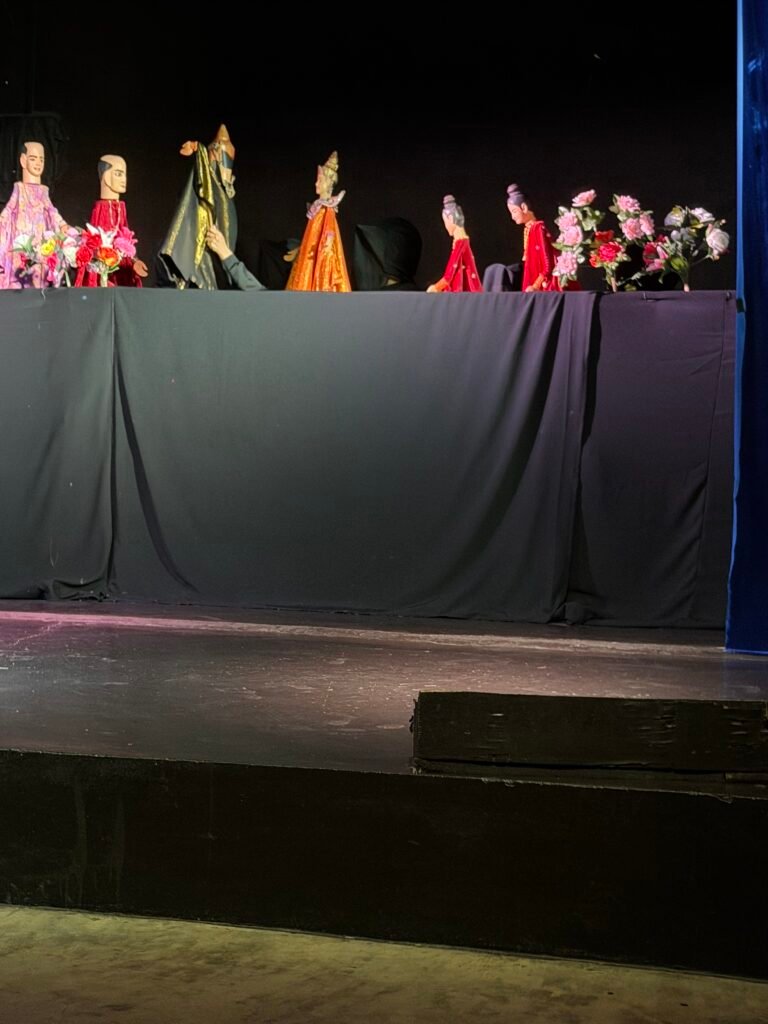
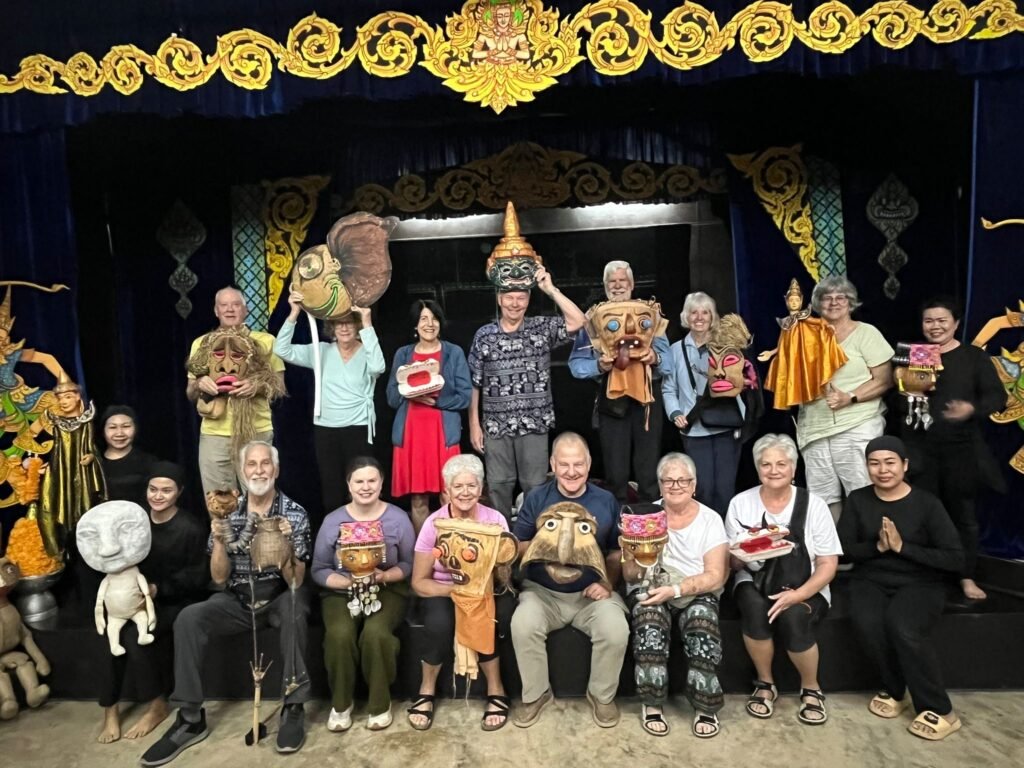
We had lunch at a local restaurant and then went to the Khon performance at Sala Chalermkrung Royal Theater. Established over 90 years ago in 1933, today’s performers keep the masked art form alive. The performers bring the stories of Thai literature to life by combining dance, martial arts and traditional Thai music. The costumes are elegant and bejeweled and the theater has earned a place in the UNESCO cultural heritage list.

Since there was a commentary above the stage in English, we were able to understand what was happening on stage. It was a short but wonderful experience, and we were all very happy to have seen the show.

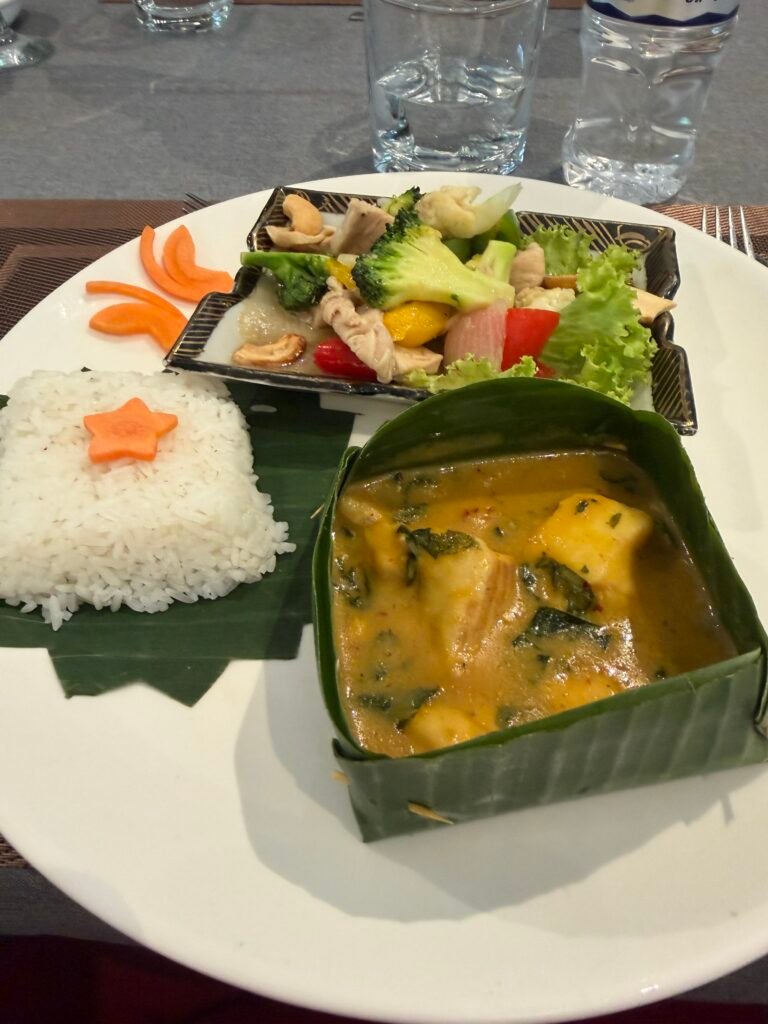
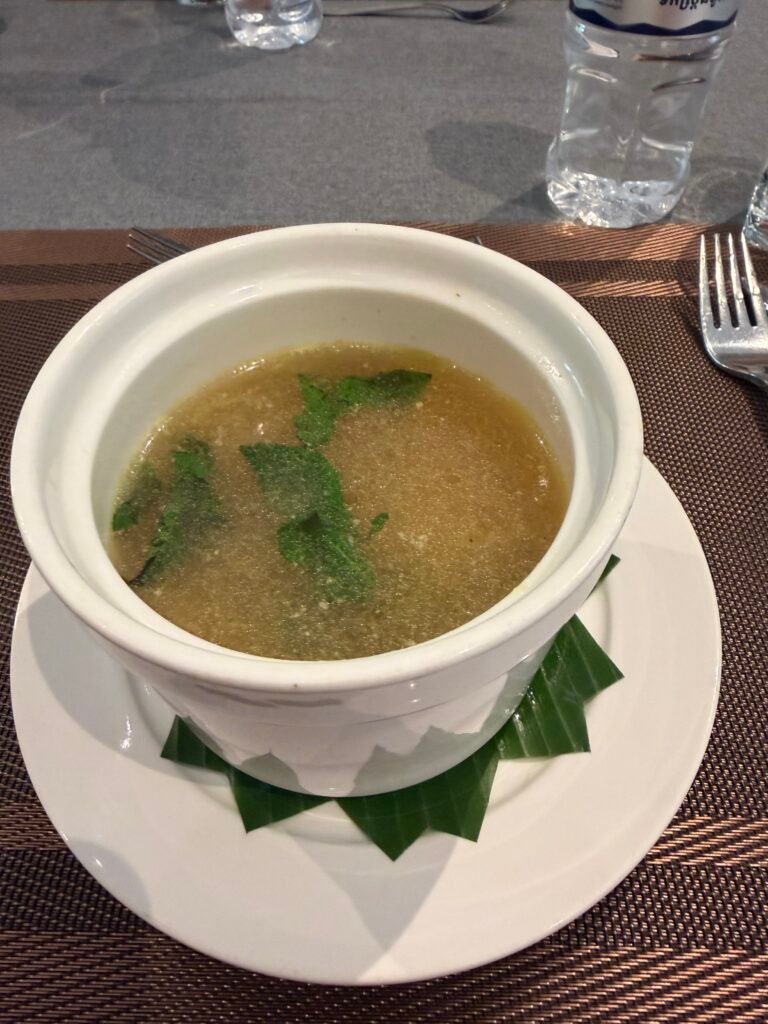
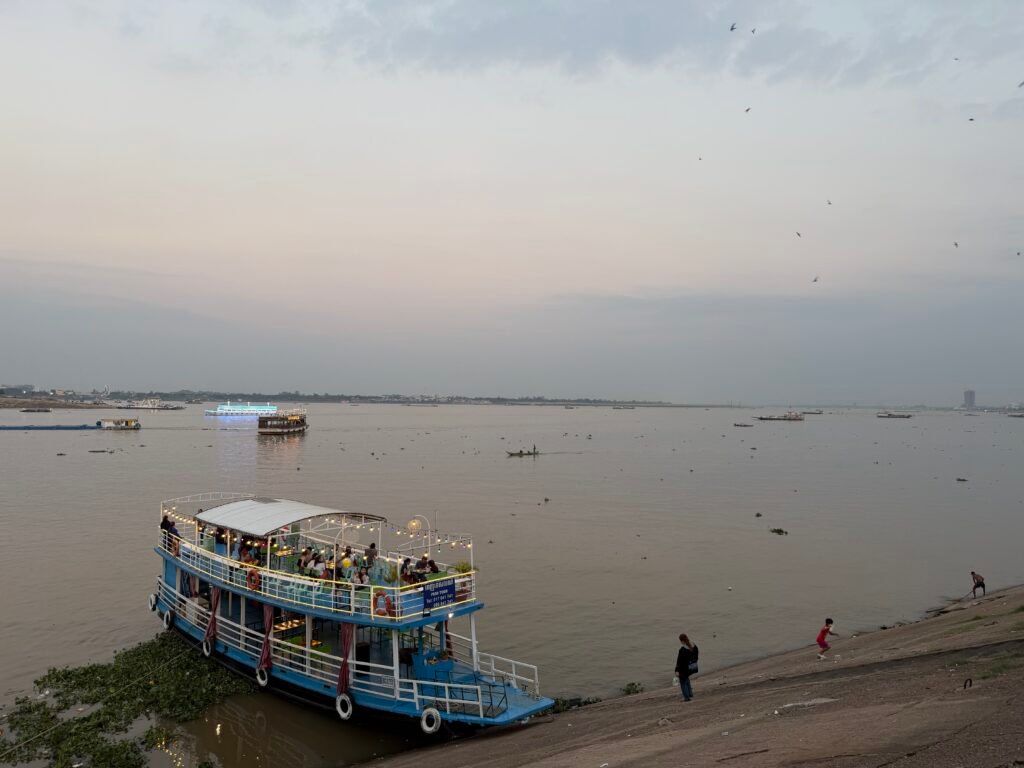
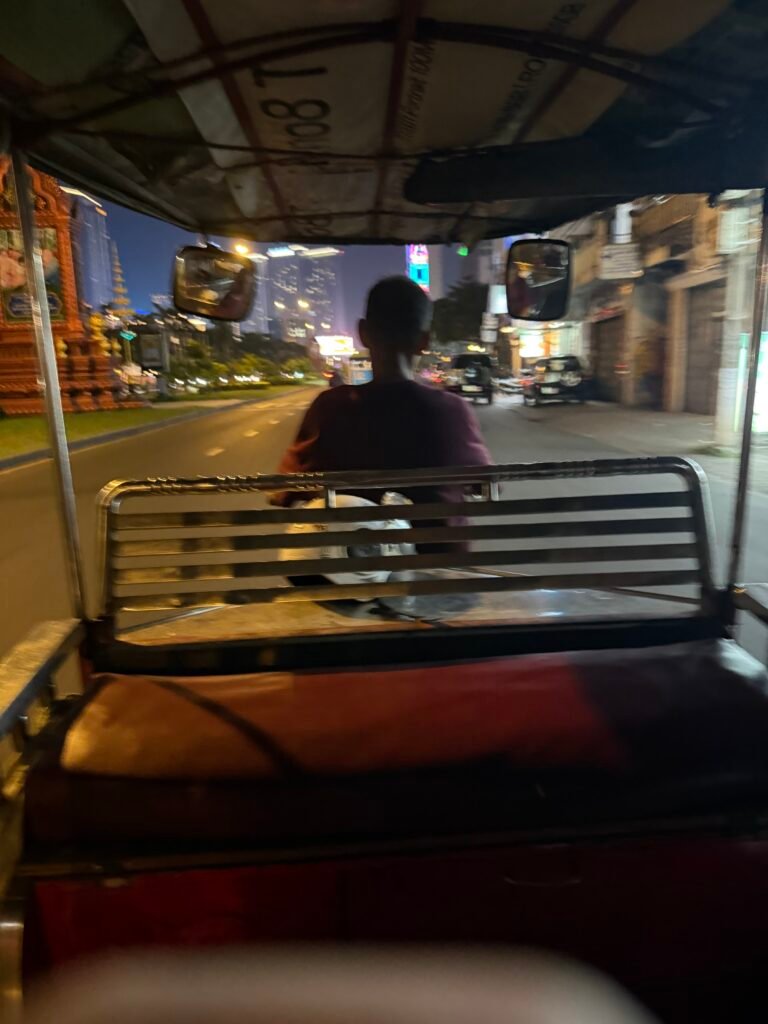
We returned to the hotel by Tut Tut – a fun (and slightly harrowing experience) and then we again boarded our bus to take us to a dinner cruise along the Chao Praya river. It was a beautiful evening as we watched the sunset and enjoyed dinner as we cruised along.
After the cruise we returned to the hotel for a nightcap with friends and then off to bed.

The Grand Palace

The Emerald Buddha

Outside of the Grand Palace

The Cloister walkway under the columns

The Than Phaithi

Standing with the guard. We had to ask his permission to take the photo

At the Khon performance at Sala Chalermkrung Royal Theater, the musicians.

Taking the tut tut back to hotel

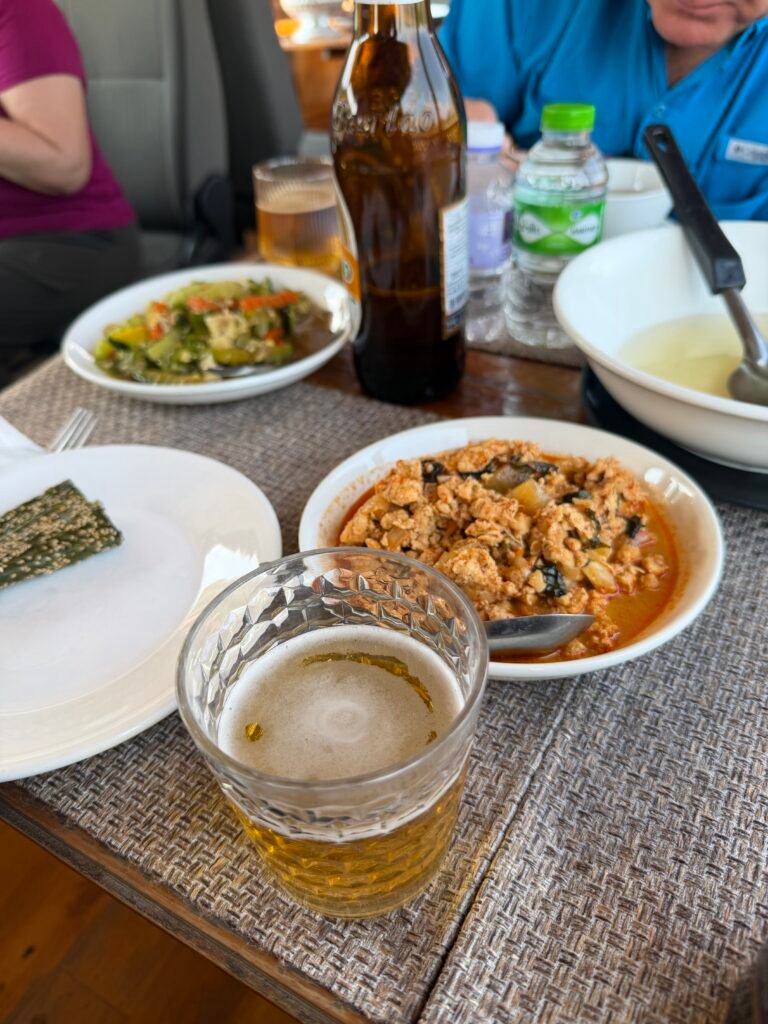
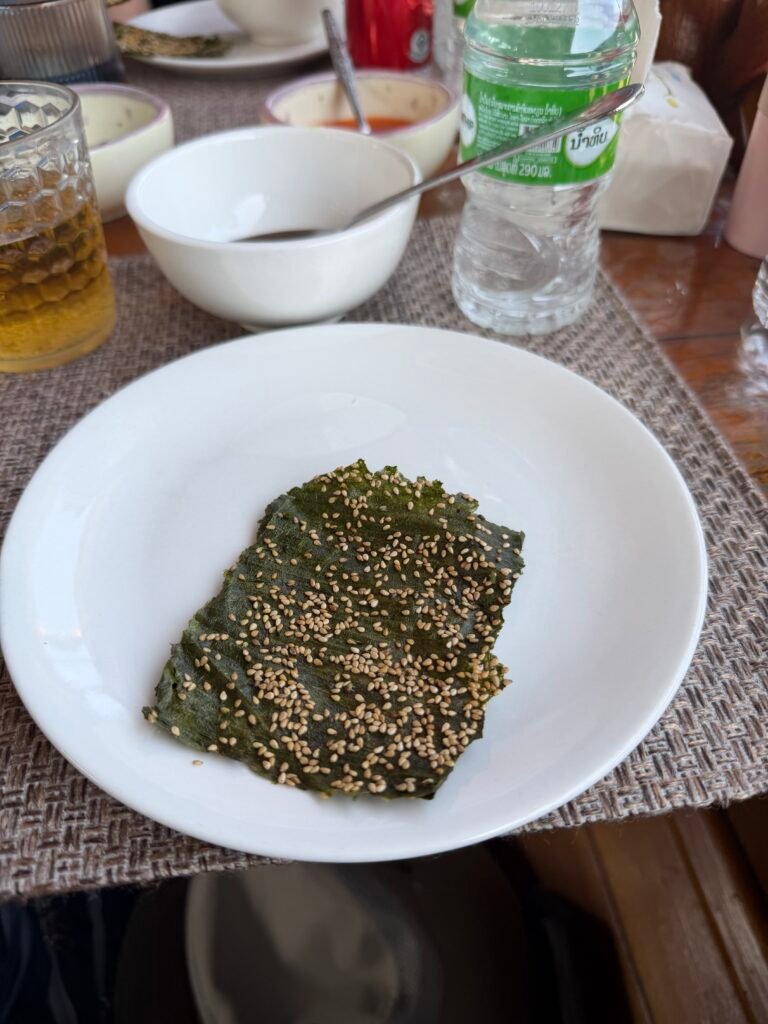
Appetizers during the river cruise

Sunset

Soup on the cruise

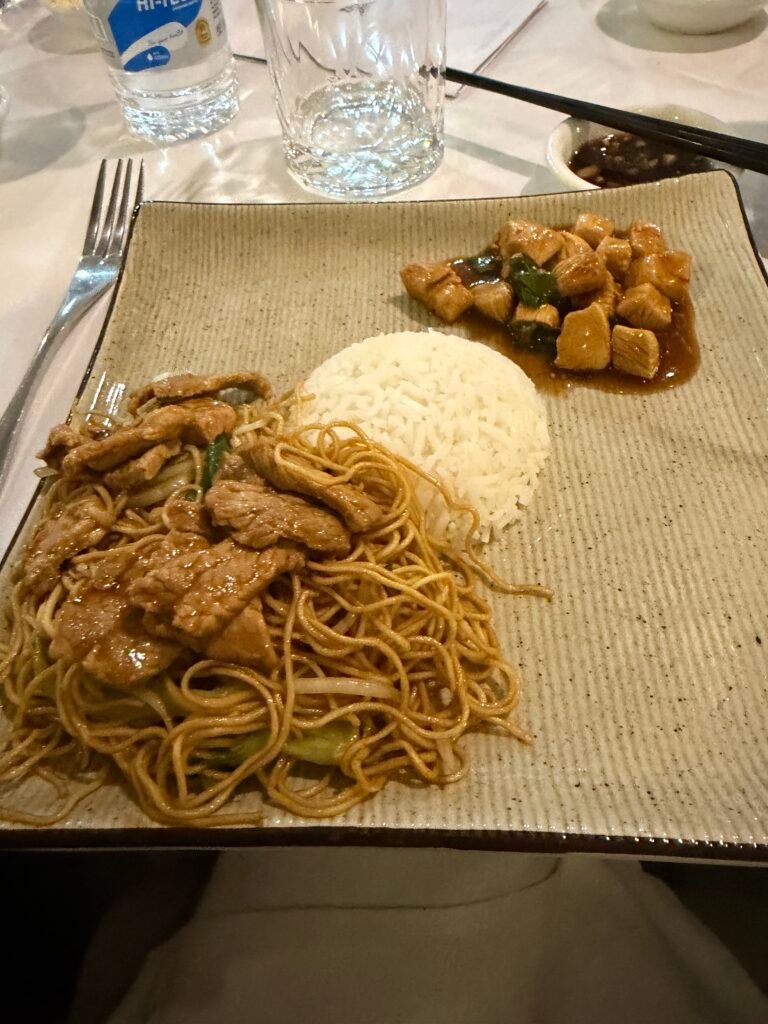
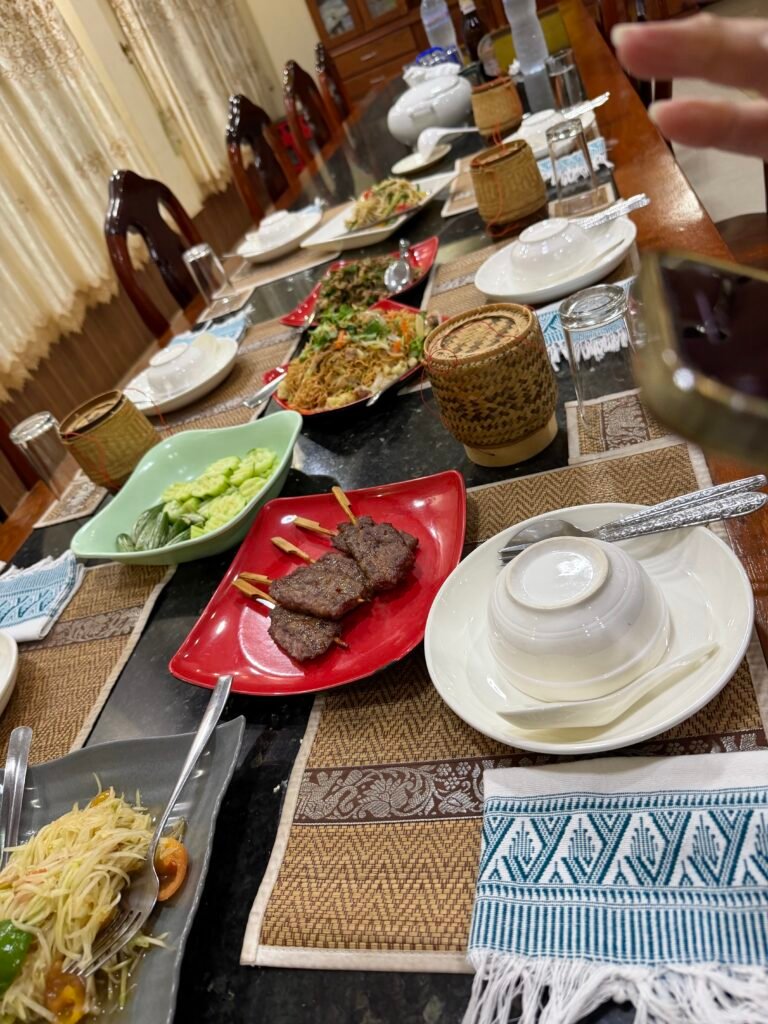
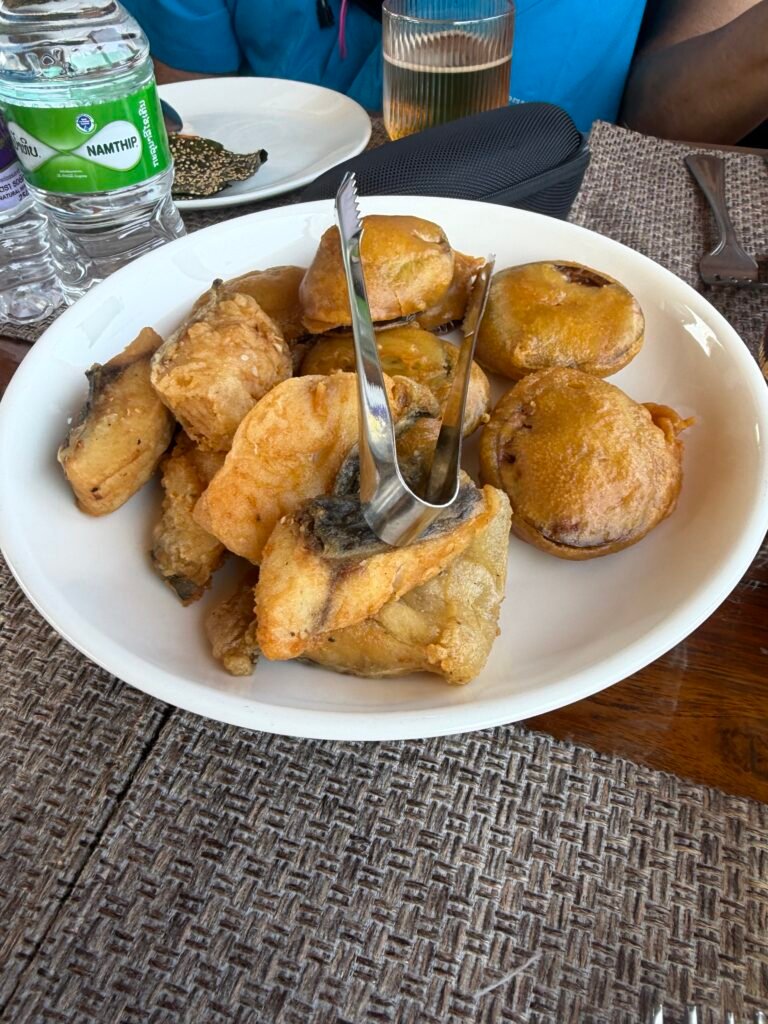
Some of the dishes

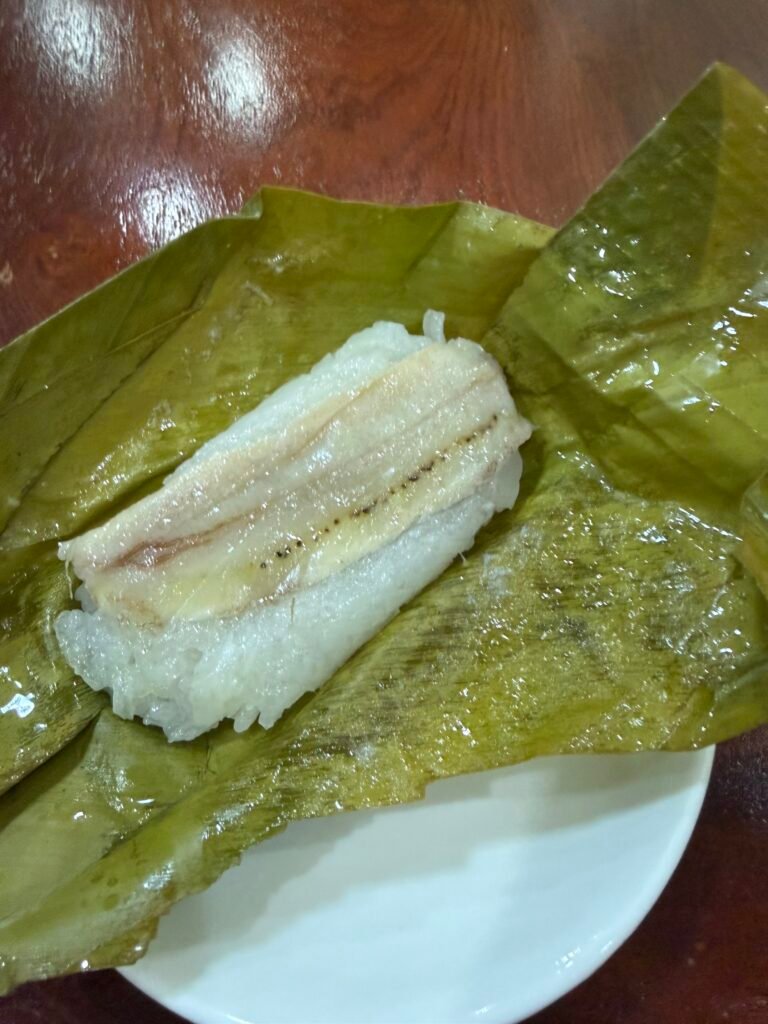
Sticky rice dessert with mango

January 18, Sunday – Discover Bangkok – Cooking demonstration

Accommodations: Bizotel Premier Hotel

This morning after breakfast, we had a Welcome Briefing where we introduced ourselves to the four new travelers joining us on the main trip. Are then went over what to expect during our visits to the countries we will be touring and he gave us useful information for each country.

After the briefing, we boarded our bus and drove to the Ruan Khun Yai house, located on the banks of the Bangkok Noi Canal. Our hosts introduced us to Thai cooking and we were able to watch as our hostess prepared Red Curry Sauce as well as Red Curry with Chicken and Bamboo Shoots.

Our hostess explained each ingredient and we were encouraged to taste and/or smell the different ingredients.

After the demonstration, we enjoyed a delicious lunch featuring the Red Curry chicken dish as well as an appetizer, delicious soup, and other authentic Thai dishes. It was delicious. I had lemon grass tea with my lunch which was very tasty.

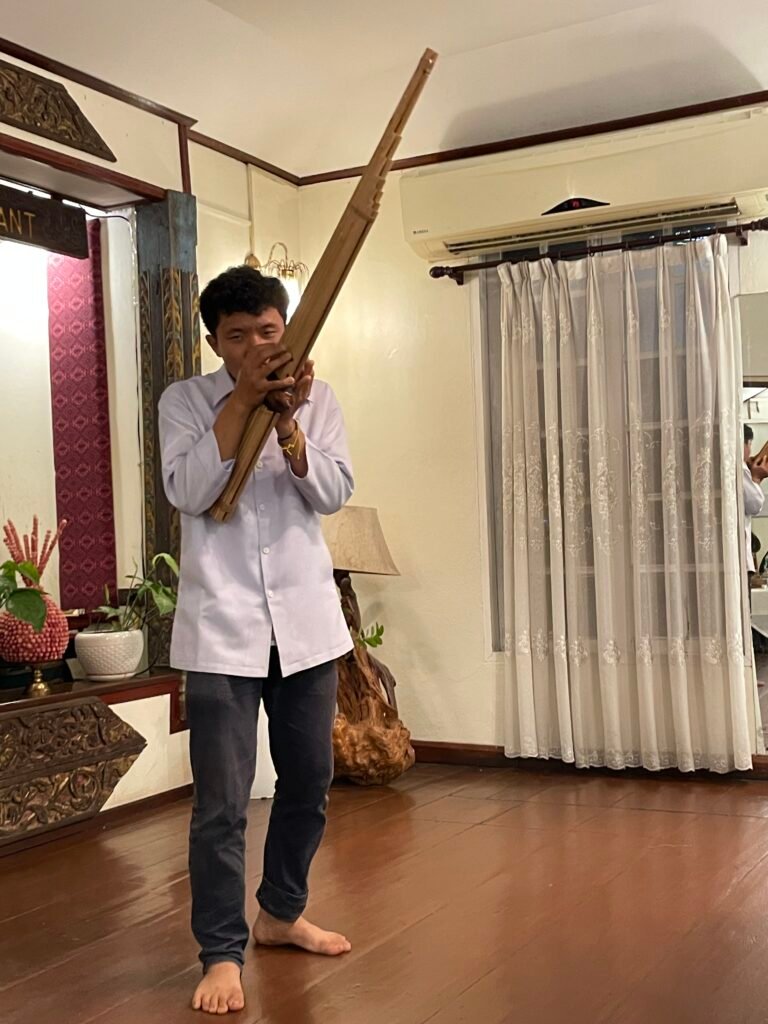
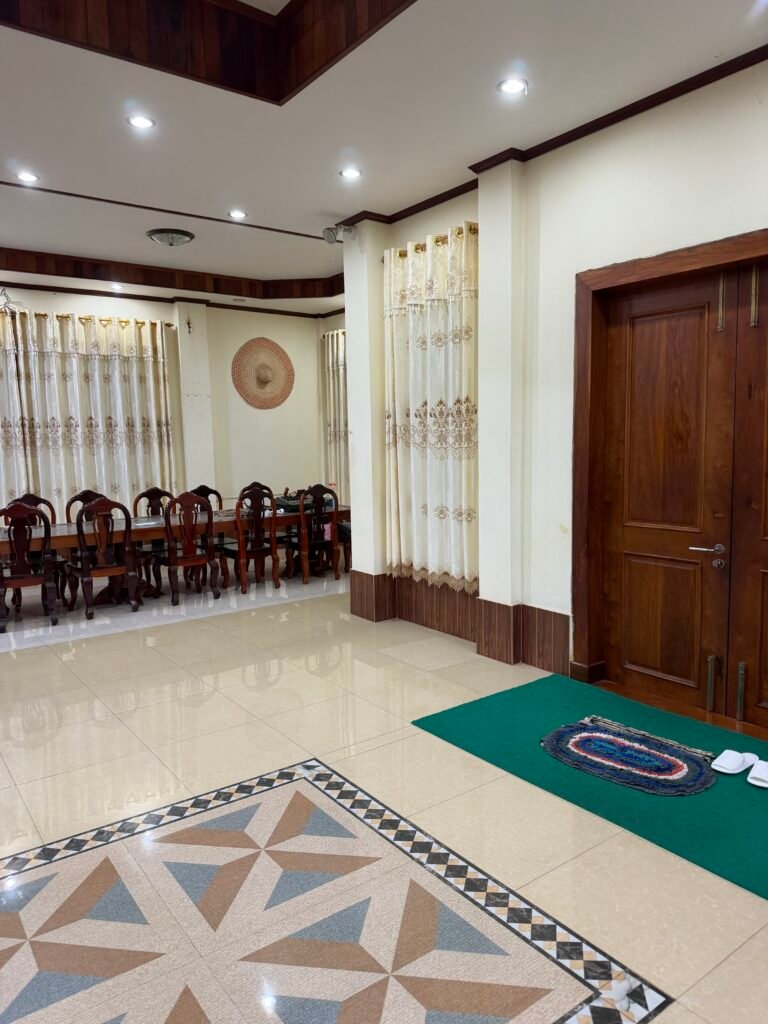
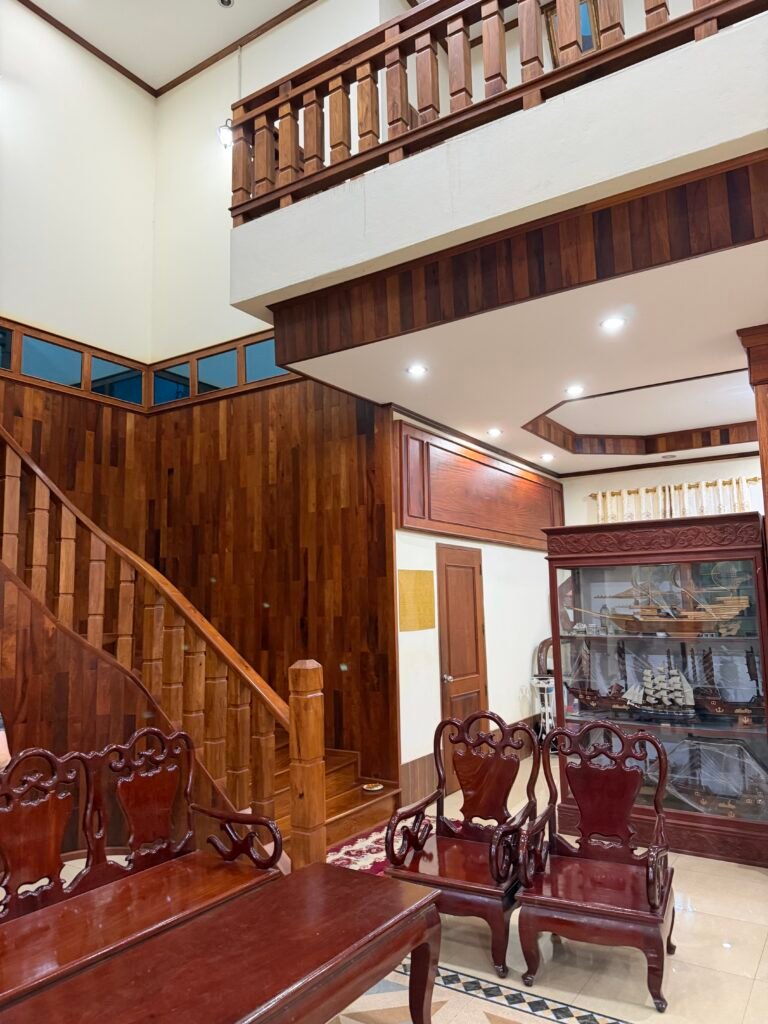
When we finished lunch, our hostess took us to tour her home. Her home is a traditional Thai style house, constructed with teak wood. Years ago the majority of homes were made of teak wood but now, only 10% remain. We admired the beautiful furniture and we were treated to a man playing the Ranat Ek/Ranat Thum, a type of xylophone that uses hard rosewood bars for bright, sharp (Ranat Ek) or lower, bass (Ranat Thum) tones, set over a boat-shaped resonator. The man who played the instrument was very talented and it was wonderful to listen to this unique music.

Friends that we met on our Canadian trip, Dianne and Dan, arrived in Bangkok to embark on the trip we are also taking, but they begin the pre-trip tomorrow, and we just finished the pre-trip yesterday. It would have been wonderful if we had known we were booking the same trip – we could have traveled together. It was great to see them, however briefly, to enjoy dinner together and catch up.

Red curry paste

Assortment of ingredients for the red curry

Preparing the red curry with chicken and bamboo shoots

It was a bit spicy hot but when mixed with rice, delicious. If something is too hot… add more rice. If something isn’t hot enough… add more chili.

Appetizer with pork and cucumber

Delicious soup

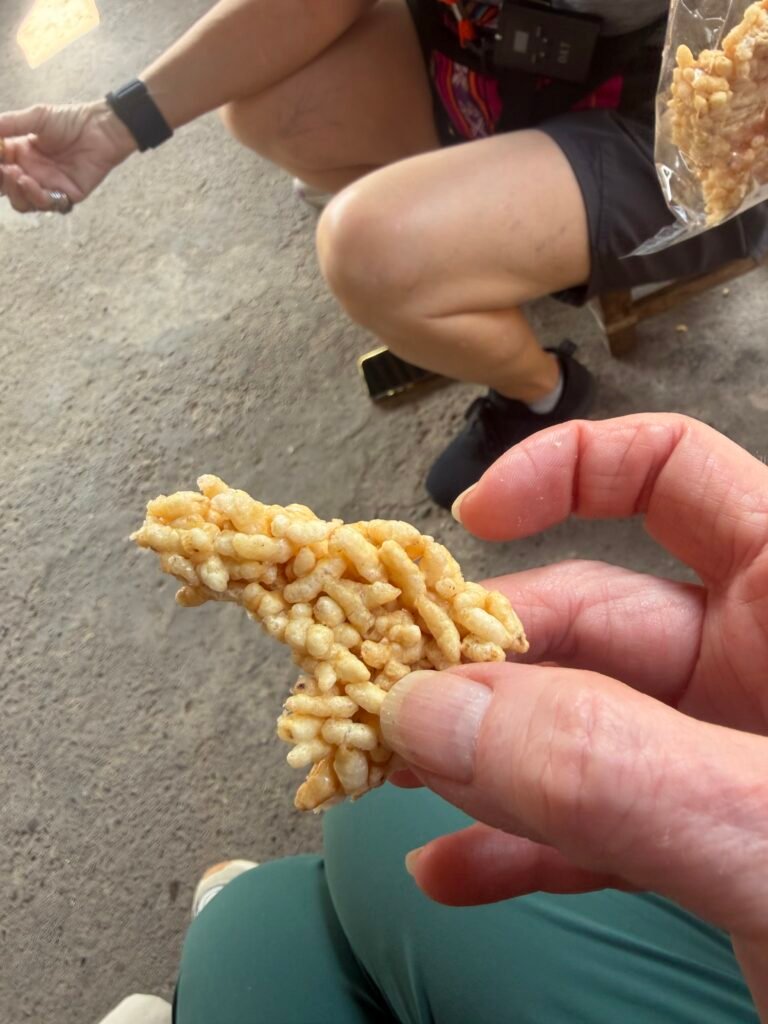
Corn and rice dessert.

The recipes

Our friends Dianne and Dan

January 17, Saturday – Kanchanaburi War Cemetery – Bridge over the River Kwai – Start the Main Trip Adventure

Destination: Bangkok Accommodations: Bizotel Premier Hotel

Last night at the camp, we saw what we since have been told were Bumblebee Bats. It is one of the few places in the world where they are found. There were tons of them flying around as we headed to dinner. They are very rare and the smallest species of bat. Wow! Who knew?

After breakfast at the camp, we boarded our bus and started on our way back to Bangkok. The camp was a wonderful respite and we enjoyed being there. It was so nice being amid nature and taking time, as they say, to smell the roses.

Along the way to Bangkok , we stopped at the Kanchanaburi War Cemetery, the main prisoner of war cemetery for victims of Japanese imprisonment while building the Burma Railway. The cemetery contains 6,982 graves of British, Australian and Dutch prisoners of war, of whom 6,858 have been identified.

After paying our respects at the cemetery, we went to see the bridge over the river Kwai (pronounced Ka-way actually). (The actual name is the Kwai Yai River.)

This steel bridge is one of the most important historical landmarks and memorials in Thailand. It was part of the railway line in World War II. After World War II, the damaged bridge was renovated by the Thai government in 1946.

The construction of the bridge was done using POWs and Asian slave laborers in unfavorable conditions. The work started in October 1942 and was completed in a year. Due to the difficult terrain, thousands of laborers lost their lives. It is believed that one life was lost for each cross tie laid in the track.

Allied forces bombed the iron bridge in 1944. The present bridge has two of its central spans rebuilt.

We were able to walk the length of the bridge and after visiting Hellfire Pass and the war cemetery, the walk across the bridge was certainly very poignant.

We enjoyed lunch at a local restaurant. As usual, the Thai food was outstanding. I wish I could remember the names of all the dishes, but no matter, they were all delicious. Are told us that usually for dessert, pineapple and watermelon are served. The way to eat it is to eat the watermelon first and then eat the pineapple. Good to know.

We arrived at the Biozel Hotel in Bangkok, where we had started our pre-trip adventure and we packed up our dirty laundry and sent it to be washed and dried at the hotel. We met friends for dinner and then enjoyed a night cap with other friends.

Tomorrow is a busy day as we begin the main trip and welcome four new folks, (who opted not to take the pre-trip), to the fold.

As we drove to our hotel, the heavens opened up with rain for the first time since we began our trip, but it was short lived and didn’t affect us at all.

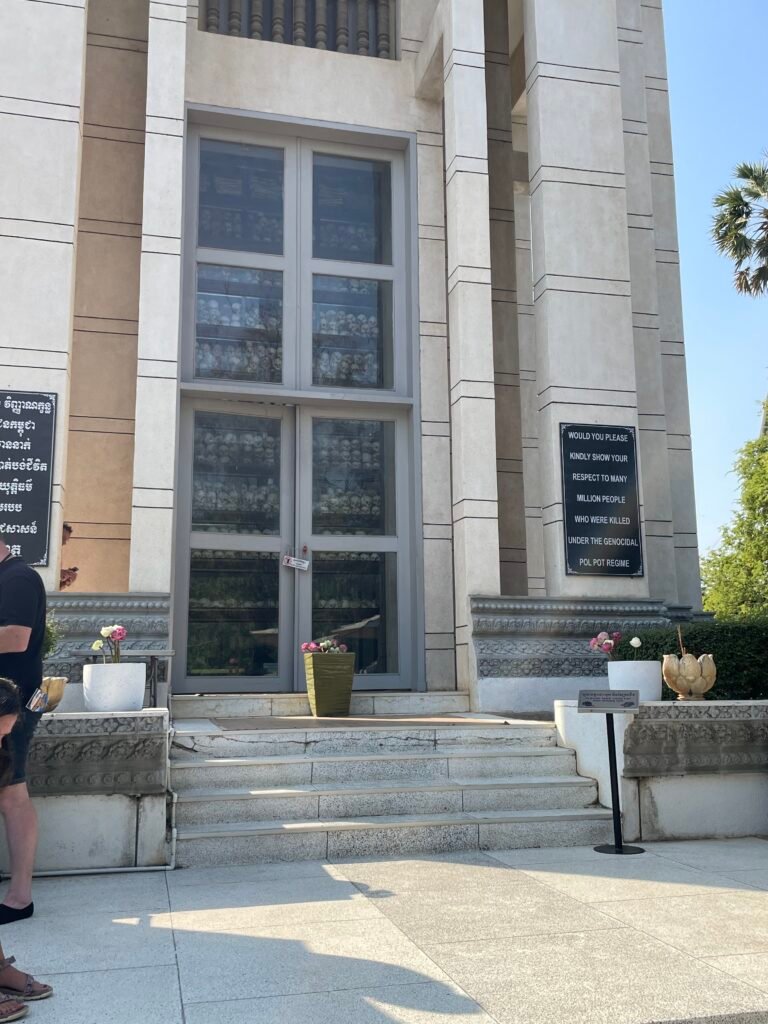
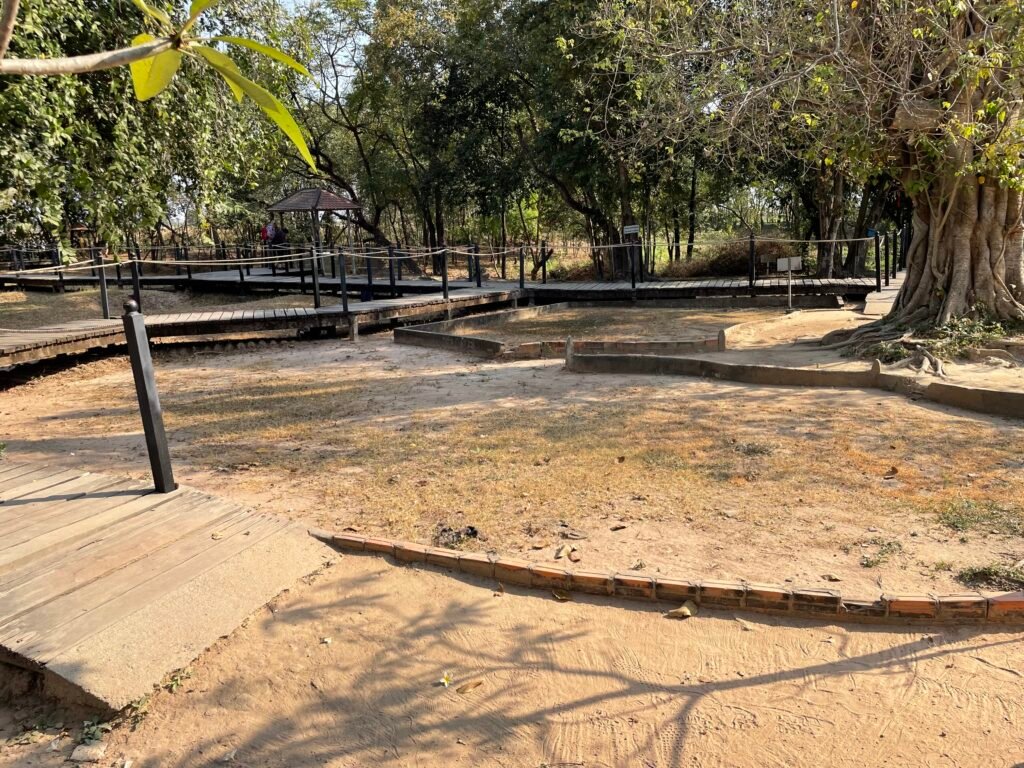
The above photos are from our visit to the cemetery

Bridge over the river Kwai. In the middle of the bridge you can see where the bridge was repaired after the bombings

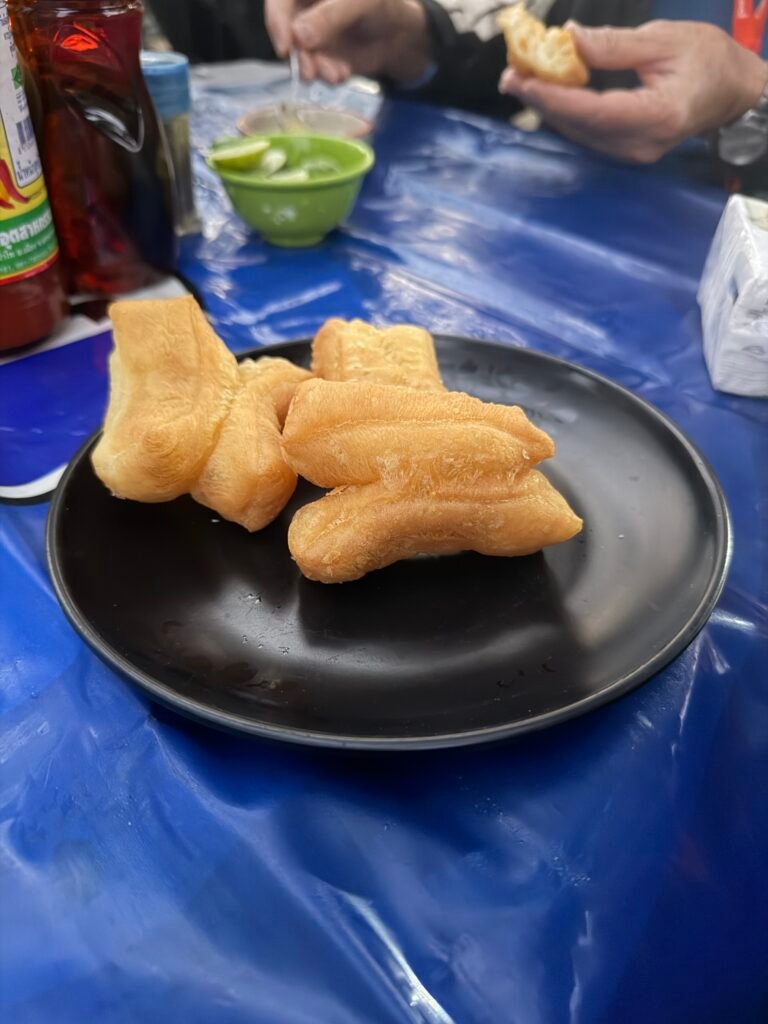
Fried noodles. Tasted sweet and delicious.

Lunch served family style. We had more than enough for seconds and even thirds.

January 16, Friday – Discover Hellfire Pass – Boat ride on the River Kwai – Visit a Latex farmer

Destination: Kanchanaburi – Accommodations: Hin Tok River Camp

We had a good night’s sleep inside our tent – the air conditioning making it quite comfortable. Breakfast was tasty and afterwards, we started our day.

We set out to visit Hellfire Pass. Hellfire Pass is the name of the area where prisoners were forced to cut through the mountain to build the Burma Railway during WW II. During the construction of the Burma Railway, it is estimated that over 100,000 people died due to starvation, disease, exhaustion, and brutal treatment. 

The total death toll is generally broken down into two main groups: Asian forced laborers: well over 100,000, Allied Prisoners of War (POWs): Approximately 16,000, Japanese Casualties: Around 1,000 Japanese soldiers and engineers also died during construction. The majority of deaths occurred among civilian laborers, whom the Japanese enticed to come to help build the line with false promises of good jobs. 

The conditions were especially harsh during the cutting of Hellfire Pass and the workers suffered from heat, dehydration, sickness, and beatings. The pass got its name because the sight of the emaciated prisoners resembled a scene from hell. About 700 allied POW’s died and 69 were beaten to death by guards.

The Hellfire Pass section of the railway was particularly difficult to cut because of its remoteness and lack of proper tools. The prisoners of war were required by the Japanese to work 18 hours a day or longer to complete the cutting, taking about 6 weeks to finish the pass.

We walked through the museum which told of the hardship the prisoners suffered and then we walked through the pass and could see the thickness and height of the rock the men had to chisel through. It was unbelievable that these men could do this work in such deplorable conditions.

After walking through the pass we climbed back up to the ground level…165 steps! Oof!

From there we took a boat ride on the river Kwai Noi to our luncheon restaurant. It was a very peaceful ride and a time to meditate and appreciate the stillness of the river, after seeing such horrors at Hellfire Pass.

Lunch was excellent and then on the way back to camp, we stopped to talk with a man who makes latex from rubber trees. He and his wife have 2000 trees and during the week, they wake up early and score the bark on maybe 200 trees and hang a cup to catch the sap. The tree produces much more sap in the cool of the morning rather than in the afternoon and that’s why they get to work so early.

After collecting the sap from each tree, they put it all in a large basin and mix it with water and formic acid. Then it goes through a pressing and stretching process to get the water out. Afterwards, the latex is dried on racks and then stored in a silo.

The man sells the latex, but he doesn’t make the money he deserves considering the hard work he and his wife do. They actually can only work three days at a time and then they take the fourth day off to rest.

They collect the sap 6 months out of the year, because once the rainy season comes, the sap would be too wet from the rain to collect. The other six months, the man does construction work to make ends meet.

The industry supports millions of households with latex extraction and processing, though small farmers like the man we visited today face challenges from fluctuating prices.

We met everyone on the veranda for a drink and then it was off for dinner. They had new dinner selections, but also had the favorites: pad Thai and skewered BBQ chicken and pork. So delicious.

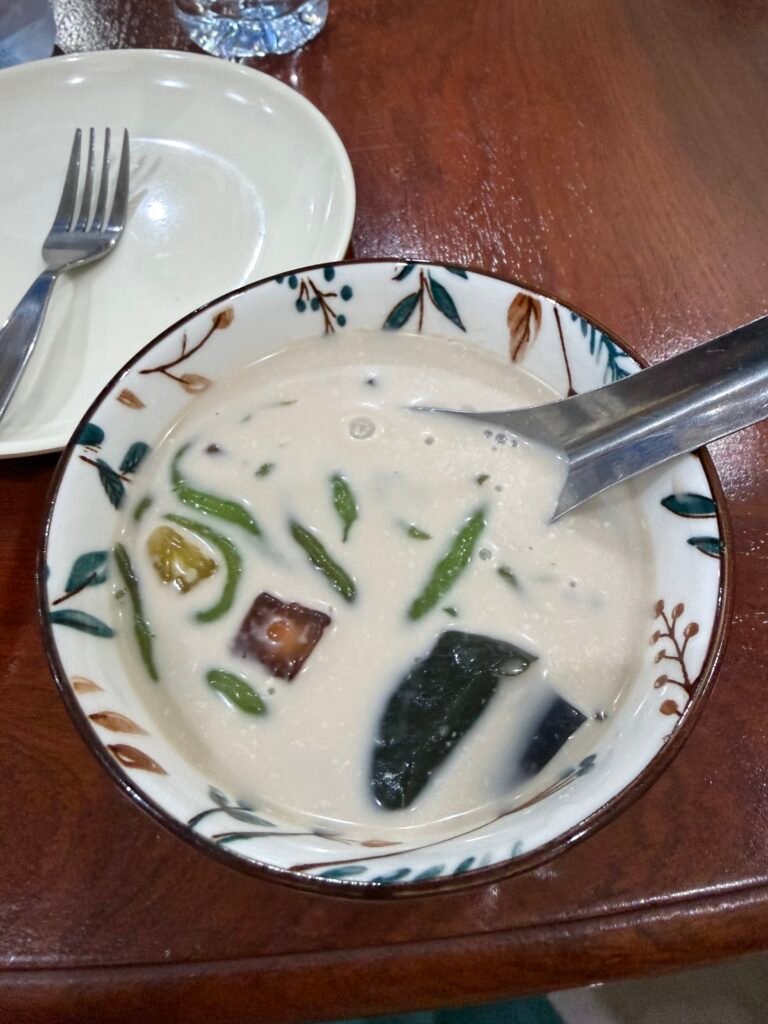
And for dessert I tried mung bean soup with coconut milk. OMG! What a treat. It is sweet and salty with just the right amount of creaminess. Apparently, it is a nutritious dessert – packed with plenty of protein and really tasty.

Tomorrow we get to sleep in and then we drive back to Bangkok.

The above pictures are at our camp. Nice to watch the sunset and drink some wine on the veranda. .
Walking through Hellfire Pass

The men chiseled through the rock with tools, some of which were broken and barely useable.

The U S Memorial

On the long boat going down the river. The boat was in a scene in a James Bond movie.

Lunch. The green vegetable dish is called Morning Glory. It is similar to spinach, but with hollow stems among the leafy part. This is not the same as the ornamental flowering plant by the same name, which is actually toxic.

The chef making the morning glory dish for our lunch. It was quite spectacular!!!

2000 trees at the rubber plantation

The sheets of rubber the man sells which are then made into different products.

The sap dripping down into the basin from where the tree was scored.

The machinery to remove the water from the latex

Mung bean soup

Our tent at night.

January 15, Thursday – Fly to Bangkok – Overland to Kanchanaburi – River Kwai Bridge walk

Destination: KanchanaburiAccommodations: Hin Tok River Camp

Today was an all day travel day, so since not much happened until we arrived at the camp, I’m going to talk a little about what we have learned about Thailand so far.

Are told us that his wife is a nurse on a cancer unit and works long hours. She only receives about $1,300 per month in salary… Even after 18 years of experience.

Thailand’s birthrate has been dwindling in the last few years. Last year there were 400,000 deaths, but only 300,000 births. Many Thai travel to other countries to work because the pay is better. Many Thai doctors who are in their residency, travel to Israel and other countries to get their experience and higher pay.

Thailand is bordered on the west by Myanmar, a country they have no conflict with.

After breakfast we flew to Bangkok and boarded a bus to take us to the river camp where we will be staying for two nights. It was a four hour ride, but we stopped along the way and picked up a bite to eat in one of the many, many 7/11’s that you can find all over Thailand.

We arrived late afternoon to the camp and I believe we can say… We’re Glamping!! The camp scenery is beautiful with outdoor eating areas, a bar, a lovely pool, nice sized canvas tents, private veranda, and spacious bathroom with a large walk-in shower.

The tent has a canvas layer as well as a second layer of netting on the entryway. Both layers have zippers that you zip up (or down) to either enter your tent from the outside, or to access your attached bathroom on the inside. On the canvas outside “door”, there is a lock that you lock with a key whenever you leave. You have to squat down to unzip the both layers and the canvas layer not only zips up and down, but sideways ads well. You have to squat down to lock the padlock on the zippers if you decide to leave the tent.

Are told us to make sure we always zip the layers closed whenever we exit or enter our tent to keep out mosquitos as well as little critters like lizards and the like.

We all gathered on the patio to watch the sunset and enjoy a drink together and then it was off to the amazing outdoor dinner buffet. They served all kinds of Thai food as well as BBQ pork and chicken on skewers. Delicious!
We all sat at the table and had a lot of laughs and then it was back to our tent for a good night’s sleep listening to the crickets.

Our tent with a king bed and a single.

Allan zipping the two layers of the walls of the tent

Camp Hintok

Our tent. So romantic. 💕

Sunset over the river
Dinner area

Yum!!

The camp grounds

January 14, Wednesday – Chiang Rai – Golden Triangle – Visit Opium Museum

Accommodations: Wiang Inn Hotel

This morning after breakfast we departed for the Golden Triangle. Are, however, asked us if we would like to visit the cave where, on June 23, 2018, twelve boys aged 11 to 17 and their 25 year old soccer coach, were stranded for days in the Luang Cave system. We said that we would, so our bus driver made a special stop for us to see it.

Since it is the dry season, we were not in any danger of flooding inside the cave. However, on the fateful day in June when the boys were stranded, an unexpected heavy monsoon rain flooded the cave’s entrance and cut off their escape route, trapping them deep inside. A massive search ensued and rescuers from all over the world came to offer their help. Nine days later, two British divers, John Volanthen and Rick Stanton, found the group alive on a small, dry ledge about 2.5 miles from the cave’s entrance.

90 drivers were involved in the rescue. They had to sedate the boys so they didn’t panic, and then they guided them through the flooded passages wearing oxygen tanks. The rescue operation was conducted over three days (July 8–10, 2018). All 12 boys and their coach were successfully brought out of the cave and transferred to a hospital in Chiang Rai.

While all the “Wild Boars” (the name of the boy’s soccer team) survived, two rescue divers tragically died in connection with the operation: a former Thai Navy SEAL, Saman Kunan, who ran out of air while delivering oxygen tanks during the mission, and another Thai Navy SEAL, Beirut Pakbara, who later died from a blood infection contracted in the cave.

We made our way into the cave, which is huge, and with our hiking poles and flashlights, we climbed as far into the cave as we were allowed to go. The entrance where we walked floods almost to the ceiling during monsoon season, and it is amazing that the boys were found and rescued so deep within the cave.

Outside of the cave is a statue honoring Saman Kunan, who lost his life rescuing the boys. He stands with oxygen tanks on his back, flippers, and wild boers surround him. The statue was made by the same artist that built the White Temple. It was a very poignant experience.

We left the cave and drove to The Golden Triangle, where the borders of three countries…Thailand, Laos, and Myanmar (Burma) can be seen at the confluence of the Mekong and Ruak rivers. We took photos and then Are stopped to chat with a man selling lottery tickets. Are bought one for the group with the lucky number 12, so we’ll see how lucky we are. The drawing is tonight.

We left the Golden Triangle and took a farm truck to a farm run by a woman who used to be a tour guide. She left that job to start a farm and she serves BBQ to folks who have made a reservation for dinner at her farm. The food was unbelievably delicious and we all loved being at the farm, enjoying the scenery, as well as the food.

Then, we visited the Opium Museum, and we learned about the history of opium in Thailand. The museum has a unique collection of opium harvesting knives, scales, weights, pipes, etc. It was very interesting to read all about opium. Thailand has been highly successful in eradicating illicit opium cultivation…
falling by approximately 97% since the mid-1980s, and Thailand is no longer a significant producer of illicit opium for the international market. However, Myanmar has apparently as of late, surpassed Afghanistan in opium cultivation.

Our last stop of the day was The Blue Temple, built by a student of the artist who built the White Temple. It is a dark shade of blue with gold adornment all over. It was quite a sight to behold. We went inside, (they let me in fortunately), and we were allowed to take photos. Inside the temple, is the pearl white statue of a Buddha named Phra Buddha Ratchamongkoi Bodi Trilokanat. If you’d like to read more about him, you can Google it.

Tomorrow we fly back to Bangkok.

The statue honoring the diver, Saman Kunan, who lost his life when his air tank ran out of air while rescuing the kids.

A photo of the flood of water coming from the cave during monsoon season.

The rescuers knew the boys were in the cave because they found their bikes outside the mouth of the cave.

This area is totally flooded to the ceiling during the rainy season.

Climbing inside the cave. Are said he explored this ewcave with his friends when they were kids.

Our group outside of the cave

The Mekong River

Where the three countries meet

The truck that took us to the farm for lunch.

Rice paddies

The history of opium

The Blue Temple

Inside the temple

January 13, Tuesday – Chiang Mai – Umbrella Factory – Wat Rong Khun – Overland to Chiang Rai

Accommodations: Wiang Inn Hotel

This morning after breakfast, we left for Chiang Rai, Thailand’s northernmost province. It has a close proximity to Laos and Myanmar, forming the famed Golden Triangle. 

Our first stop was the umbrella factory. This was an unplanned stop, but one Are thought we’d enjoy. He was right! It was very interesting to watch each step of the umbrella making process – all done by hand – take place. The beautiful umbrellas were being created in a myriad of vibrant colors. One group of ladies was assembling a huge order in a vibrant pink to be sent to a client in the states.

The ladies who work at the factory have been working there for years. They don’t make much money for their labors, but what they don’t receive monetarily, they make up for with socializing with their friends as they work. One lady has worked at the factory for 50 years and she said the place is like family and a much better alternative to sitting home alone. The work is delicate and takes skill, but sadly, most of today’s youth are not interested in learning the techniques needed to make these beautiful umbrellas.

After leaving the umbrella factory, we had a rather long drive and then stopped for lunch. Even though the drive was long, the scenery was lovely and the time flew by. We ate outdoors and the feast that was presented…all Thai favorites…was unbelievably tasty. We all said we definitely ate way too much, but it was so good.

After lunch we drove to the White Temple (Wat Rong Khun). I was afraid I would not be allowed in because you have to remove your shoes and for me with my foot, that wasn’t going to work, because going barefoot at this point isn’t the best. Are spoke to the guard on my behalf and explained my plight and since I had brought booties to cover my sneakers, they let me in. People take off their shoes in temples as a sign of respect and humility. You are leaving the dirty mundane world behind to enter a clean and sacred place and you are recognizing the temple as holy ground. I was so happy that I had thought to order booties before we left, and at least in this temple, they agreed to admit me because of them.

Wat Rong Khun, is quite the site to behold. It is very contemporary, and glistens in the sunlight. The temple is made of concrete with a wooden roof. Viewed from a distance, it has a dazzling effect against the blue sky, mainly because of the whitewash used on the surface as well as the thousands and thousands of little mirrored chips that are embedded into the concrete, that catch the sun’s rays and sparkle.

Construction on the temple began in 1997 by local artist Chalermchai Kositpipat. Before you walk into the temple, you have to cross a bridge with a pit below filled with reaching hands which is supposed to symbolize souls reaching up from hell. Then, when you step inside, you have gone from hell into heaven. Once inside, you cannot go back outside that same way. The symbolism being… you are leaving hell behind. Inside the temple is a blend of Buddhist art as well as contemporary art, featuring Michael Jackson, Harry Potter, minions, cartoon characters, and many more icons of pop culture. The mural depicting the pop culture is controversial since many people believe it has no place in the religious temple. But the artist wanted to make a statement on modern life: human greed and the struggle between good and evil. He also wanted to illustrate Buddhist teachings in a way young people would understand. We were not allowed to take photos inside the temple.

Kositpipat considers the temple to be an offering to Lord Buddha and he believes the project will give him immortal life. Today his work is ongoing, and expected to be finished by 2070. When completed, the white temple compound will have nine buildings. We walked around the compound and saw the beautiful flowers and the buildings that are currently being built.

After our temple visit, we drove the rest of the way to our hotel. The hotel is in a prime location: everything you could possibly need is situated within two or three blocks.

We all went out to dinner at a local restaurant and we ordered the restaurant’s signature dish – pork with spices and lots of ginger. It was delicious.

After dinner, Allan and I walked through the streets where venders were setting up shops. I bought some lovely gauzy summer pants which will be great for traveling and for the summer. They each cost 100 baht…or 3 US dollars!! Two pairs of well-made summer pants for 6 dollars! What a deal!!!

This lady has worked at the factory for 50 years.

Making the paper part of the umbrella.

Myriad of umbrellas

The dyed paper for the umbrellas

Delicious lunch. So many things were presented for us to eat.

Passion fruit. Are said to put a little salt in it. Delicious!

The White Temple

Depiction of Hell before you enter into the temple.

Amazing detail in the architecture.

January 12, Monday – Chiang Mai • Visit Karen hill tribe village • Elephant care center

After breakfast, we boarded our bus and drove to the Karen Long Neck Village, where we were able to chat with a resident of the village. When we arrived in the village, we transferred to a pickup truck which took us to the resident’s home. The ride was bumpy and steep and we had to hang on for dear life. The resident spoke Thai and Are was able to speak with her and relate the answers to our queries back to us.

The name of the lady we spoke to is Mabai and her daughter’s name is Macao. Macao is four years old.

Mabai originally came from Myanmar, but she fled because of the conflict in that area and then settled in Northern Thailand. She is a member of the Padong people. The Padong women are known for the brass neck rings they wear around their necks.

The Padong have their own language, although some Padong are able to speak Thai. They rent their land from landowners (which is about $100 for the year), and then they build homes with bamboo and they use mulberry leaves and elephant poop for the roof. They follow the law in Thailand that children must attend school beginning at age five.

They earn money by selling handicrafts like hand woven goods, jewelry, and souvenirs. They live in designated tourist villages and they get some income from the tourist entrance fees.

The Padong women wear very heavy rings around their necks made of brass that weigh over 4 lbs. The rings are usually put on the girl around the age of four and they are remade as the child grows. When a mother has a young infant, she usually does not wear the rings while the baby is young because it would be hard for her to bend her head to look down to nurse the baby, etc.

Only a person with skill will fashion the rings for the women and children, as the rings have to be wrapped around the neck carefully. The brass is very cold against the skin so some women tuck a cloth inside so the rings aren’t next to the skin.

Most young girls are not forced to wear the rings by their parents, but some choose to do so to continue the culture. Others choose not to wear the rings when they go to school because sometimes, if they wear the rings, they are bullied and made fun of by their fellow students. Mabai told us that when she goes into town she usually wraps a scarf around her neck so that she doesn’t become the main attraction for ridicule and to avoid having people stare at her.

There are many theories as to why the Padong women wear the rings. Some say that the tradition started to prevent the women from the advances of men from another tribe. Another theory is they wore them years ago to appear intimidating if another tribe attacked them while their men folk were out hunting. And yet another theory is that originally the rings were made of pure gold and by wearing the gold next to their necks, it showed status as well as keeping the gold safe. Most Padongs say they do it because their mothers did it, and their mother’s, mother wore them, as did their mother’s, mother’s, mother, and so on.

If anyone gets sick, they can go to the local hospital which is about 30 minutes away by scooter. They grow their own vegetables and Mabai said that her husband works at the elephant center.

Mabai said her day starts around 5 am when she prepares breakfast. She gets her husband off to work and then takes care of the children and straightens the house. Then she makes souvenirs and does some weaving. She also has to bring water from the well for cooking. Lunch time rolls around and she prepares the food for her husband and children. Then it’s back to making trinkets, tending the garden, and then starting dinner. It’s a full day.

We said goodbye and then walked over to the elephant center, where we met a mahout – a local – who takes care of the elephants.

The elephants are truly gentle giants. These animals are fed, bathed, and socialized at the center and some of the elephants have been there for quite some time. We met Tata, an elephant who has never been in the wild. Her mahout has been with her for a few years and she listens to him very well. We were able to get close to her, pet her, and have our pictures taken with her. The guide answered questions that we had about “a day in the life of an elephant” at the center and it was very interesting.

After meeting Tata, we visited the museum on the premises, which enlightened us even more about the Asian elephants.

After the museum visit, we went to where they make paper out of elephant poop. The poop is cleaned throughly with water, pounded and mixed with grasses, and put into a huge vat of water. There’s a screened form that they gently scoop the poop mixture up on and they let it dry. It becomes a hard piece of paper that they make into stationery to sell at the gift store.

Our day of discovery continued as we watched our local guide put vegetables, fruit, raw rice, and cooked rice, etc into a big wooden container and some of the folks took turns pumping a large wooden mallet to mash everything together. Then we all got our hands nice and gooey as we formed the food into baseball sized balls. Then the fun began!

We walked over to the yard where the elephants were and as soon as they saw us coming, they all lumbered over to the fence. They knew it was feeding time. We all took turns feeding whole bananas, including the skin, and the balls of food we had just made to these gentle giants. The elephants took the food with their trunks right out of our hands and sometimes there would be three or more trunks coming at you wanting to be fed. It was so much fun and we had a great time. It seemed like they were overeating, but actually, elephants consume about 300 lbs of food a day so we just kept shoving the food into their hungry mouths and trunks.

After that, the people who had donned their bathing suits already, went to the water area and waded in to bathe the elephants. I was so disappointed because I would have loved to have taken part in that activity, but I couldn’t take a chance walking barefoot so soon after healing from my broken foot.

The elephants loved their spa time and then everyone who had participated showered and changed clothes and we all set down to a delicious lunch. Allan and I had the chicken Pad Thai.
We said goodbye to all the folks at the elephant sanctuary, and took the bus back to our hotel. We had a few hours until dinner, so most of us just rested in our rooms.

Then, since Are had made reservations for us a few days ago at The House by Ginger, we all walked over to the restaurant for dinner.

The House by Ginger has been recognized for the last few years by the Michelin Guide receiving the Bib Gourmand award. Most of us ordered the restaurant’s signature dish – Khao Soi – a coconut curry soup, and everyone enjoyed it. Everyone but me! I hardly ate it. I had asked for little to no spice, but it was pretty spicy hot. I didn’t like the chicken or the broth, and Are suggested I add more coconut milk, which I did, but it wasn’t any better.

Allan and I then ordered a tapioca dessert called Sago, which came out hot and had things in it we had no idea what they were. Are didn’t know either as they weren’t mentioned in the description. I wasn’t a fan of that either, so I was glad I had enjoyed a lunch at the elephant sanctuary and could pass up dinner. I should have gone with what I originally had wanted – Tom Yum soup – which I love, but everyone was ordering the signature dish so I changed my mind. Oh well.

Except for my dinner, it was an amazing day of discoveries!!

The necklace that the Padong women wear. It is very heavy and cold.

Mabai and her daughter.

All the ladies wearing a covering so we didn’t get slimed by the elephants. Everyone except me had also worn the covering to bathe the elephants.
Spending time with Tata. The local guide told us that if you take a rope and measure the circumference of an elephants foot close to their toenails and then double that measurement, you will be able to determine the elephants height. He showed us. Amazing!

The food that we made the feeding balls with

Mashing the food

Allan feeding bananas

The elephant was so gentle taking the food from my hand.

The elephant spa

Our lunch at the elephant sanctuary. Delicious!

My dinner at House by Ginger

Our Dessert called Sago. Meh.

January 11, Sunday – Chiang Mai – Visit local village – Waterfall hike

This morning we sat with new friends Phyllis and Bruce for breakfast and we enjoyed chatting with them and finding out about their lives. Bruce at one point told me I had a “delightful accent”. Wait!!! I have an accent????? 😂

After breakfast, we rode for over an hour, to Mae Kampong town, (a village of about 130 houses with about 370 residents), to do some hiking. Mae Kampong is tucked between the mountains and the forests and has become a haven for tourism. Interestingly, about 95% of the folks who visit the area are Thai, usually from Bangkok. They come to enjoy the mountains for vacation since this time of year the weather is cool, dry, and a perfect vacation spot.

There are no big hotel chains in the town. In the early 2000’s, residents of Mae Kampong decided to offer their homes for people who wanted to vacation here. The cost is about $20 a night… And that includes two meals!!! What a bargain!!

Are told us that tourism, the precious gems industry, (which consists of rubies, jade, and sapphires which are fashioned into jewelry and exported), farming, tea, and coffee are the main businesses in the area. We drove past signs that said vineyards ahead (Allan got excited), but the vineyards were not grape vineyards, but rather strawberry vineyards! Go figure!

Tea leaves had been cultivated in the area and later on, coffee began to be cultivated. There are many cafes in the village where they serve locally grown coffee to the tourists. In Mae Kampong, its own inhabitants are in charge of managing the tourism, and they directly pocket its benefits.
We passed by a lengthy stretch of land where large trees were being sold. The trees had the root balls attached. Folks who were doing new landscaping, and didn’t want to wait for a sapling to reach maturity in their landscaping scheme, could purchase these trees and plant them. Viola! A beautiful yard with fully-grown trees in a day. An amazing enterprise!
We arrived at the area to begin our hiking and we were offered two hiking trails to embark on. One would be a short hike and one was a more challenging hike, with steep and slippery terrain. Given my foot, we opted for the short hike, as did five others in our group. It still was a very challenging hike and we were glad we had our hiking poles with us. We had to navigate over tree roots and huge rocks as we steadily climbed higher and higher. Along the way we saw the coffee beans growing as well as some beautiful foliage.

Wonder Woman…aka Irene Leslie… again came to someone’s rescue. One of the men (Bruce) was trying to navigate an extremely tall step and lost his balance and started to fall backwards. I was right behind him and was able to stop his backwards fall by pushing my hands firmly into his back. The local guide and our guide were then able to grab his arms to help him up the step. Bruce thanked me and said it was so fortunate I was behind him to stop his fall!

I’ll be here all week folks!😂

When we finally arrived at the top of the trail, we were able to sit down and enjoy an amazingly robust cup of coffee brewed from the locally grown coffee beans and we paired it with a slice of lemon cheesecake. Delicious! We then met up with the rest of the group and walked to some beautiful waterfalls.

Afterwards, we had a very nice lunch with a lovely view of the forest. I wasn’t a fan of the tilapia that was served, but the Kom Tom soup was outstanding as was the chicken.

We boarded our van and drove to the “House of Many Elephants” or Baan Jang Nak. Phet Wiriya is the founder of Baan Jang Nah and is a descendant from the Tai Yong people who migrated to Lamphun province more than 200 years ago. He is a master carver, creating stunning replicas of elephants from different woods, cement, and also putting together scraps of wood to create masterpieces that are sold all over the world. The place also encourages other woods carvers to work in the shop and as we walked around the myriad of elephants, you couldn’t help but be amazed at the artistry.

On the way back to the hotel in the van, we talked with Are about words in a foreign language and how you have to be careful when speaking different languages to make sure the intonation of the word you are saying is correct. Are gave the example of pho soup in the Vietnamese language. Most people say “fuh” rhyming with “duh”. According to the internet, since the Vietnamese use tones when they speak, the word phở, meaning soup, actually has a dipping tone (down then up) with a gentle lift at the end when pronounced. Are said that with an incorrect intonation of the word, it could be confused with the word Phò, the slang term for a prostitute, which is pronounced with a downward, or “heavy,” intonation. Proper pronunciation and the use of the correct tone is essential in many languages to convey the intended meaning and avoid misunderstandings. Are said he was in Vietnam years ago and was very hungry and ordered pho soup. The waitress said “What???? Are you sure???” to which Are said “Yes!!!” She kept asking him “Are you sure?” And finally he said, “Yes. I’m very hungry sees e!” Aha! She realized he wanted the soup and not a street walker! Allan will have to remember that the next time he orders ‘pho’ soup in a Vietnamese restaurant! 😳 (I actually recorded Are saying pho…the soup, so we can practice the correct intonation!)

We arrived at the hotel and had time to freshen up and then we went for dinner at a Thai restaurant. The dinner was served family style and each dish was outstanding.

After dinner, we all stopped at a street fair to see what it was all about. Are told us that we ladies should be on the lookout for elephant pants, a light fabric lounging outfit that is very popular. He said don’t buy at the first stall you see, but rather walk around and compare prices. That sounded like a good idea, so off we went to bargain hunt.

We didn’t know the place woud be crazy town!!! Thousands of people were jammed packed across the aisles and you could barely move. Allan spotted a vender very quickly and we went in, asked the price, it sounded reasonable, we purchased, and went back to the hotel, glad to get away from the frenzy. Allan said that since we didn’t have enough baht for the purchase and the vender accepted US dollars, we made out very well with the currency exchange rate. They actually gave us a really good deal.

We meet friends for a glass of wine at the hotel and then it was to bed! It was a fun day!

View from the culmination of our hike.

The pic below is what the locals use to make whisk brooms with.

At the waterfall

Amazing wood carving

This piece is carved from one piece of wood

At the restaurant, our chicken was flambéd at the table.

One of the dishes. The basket was edible.

Our rice serving.

January 10, Saturday – Chiang Mai, Thailand

Accommodations: Amora Hotel Tapae

Morning: Fly to Chiang Mai

This morning after breakfast we flew to Chiang Mai.
Chiang Mai is known for its ancient temples, vibrant markets, mountainous scenery, and relaxed atmosphere. The flight was only about 1 1/2 hours and then we boarded the bus to the hotel, passing by the beautiful scenery. Chiang Mai’s scenery is very different from the sky scrapers of Bangkok. There are only a very few moderately tall buildings and flowers were blooming everywhere. We passed the remains of the ancient city wall with the surrounding moat, that was the defense of the old city during the 13th century.

Since our rooms weren’t ready when we arrived at the hotel, we all went across the street to enjoy some Thai food for lunch. Our group is very nice and I’m sure we are going to have a great time together.

We met our guide Are at around 4 pm and he took us on an hour plus walk around the area – deftly crossing the traffic that zooms through the streets by raising an arm and plunging ahead when the coast was pretty clear. Raising a hand and looking like you mean it does cause the traffic to stop…but you still have to be careful of rogue motorbikes that just keep going.

Are pointed out currency exchange places where you could get a pretty good rate, the pharmacy, the convenience stores, etc in case we need them. Chiang Mai sidewalks are practically non existent. They are very narrow and you have to be careful of the potholes and loose cement. Trees are growing sometimes right in the middle so you have to navigate around them and telephone wires sometimes hang down from above so you have to duck when you approach. But tucked within this seemingly unnavigable atmosphere, are beautiful temples, fabulous eating places, and gentle people who smile and bow to you as you pass by. Bangkok was filled with venders selling their wares as you walked along, but the streets in Chiang Mai hardly have any. There are many stores lining the streets, but you conduct business inside.

Are told us it is very rude to raise a finger to point something out in the distance that you want your fellow companions to see. That was good to know since i believe most Americans are guilty of doing just that. (Even though I do remember my mother saying to me as a child, “Don’t point!”)

Are told us that he spent time as a monk and even though that journey was short lived, it taught him much about the ways of life which he still tries to practice: Meditation to develop concentration and insight. Mindfulness to pay attention to the present moment, and Compassion – by cultivating kindness and adhering to moral principals by not stealing, lying, or harming. I feel that Are definitely incorporates those values in his daily life, which is evident in his demeanor and the way he interacts with the group.

While we were walking in a plaza, where no cars were allowed, I noticed that a pickup truck was in the plaza and was backing up. Most of the group kept walking and following Are, but one of the ladies in our group (Sue), stopped to take a photo, not seeing the van behind her. I paused, thinking surely the van driver sees her in his rear view mirror. But no… he kept backing up. In a split second my instincts took over. I knew I couldn’t push her out of the way because then I’d be behind the van. Instead, I yelled and flew to the side of the van and pounded like a crazy woman on the metal! The van stopped literally inches from her. My adrenaline was in full force and my heart was beating out of my chest. Afterwards my hands were literally shaking. Sue thanked me profusely. The rest of the group didn’t realize what had happened since they had continued following Are. It was just lucky I had been in the back of the group at that moment and saw the scene unfold before it could have had a very different ending.

Irene Leslie – filling in for a few moments as Wonder Woman. Whew!!!!

Then a few minutes later as I was approaching an alleyway, a motorcycle literally flew out literally inches in front of me and if I hadn’t come to a sudden halt when I saw the wheel out of the corner of my eye, he would have run into me. Another Whew!!! This time, someone above was watching over ME!

We walked back to the hotel and since it was about 5:30, Allan and I decided to freshen up a bit and have a quick bite to eat. The entire group, Allan and I included, had a terrible night’s sleep last night once again, so we wanted to stay awake as long as possible and hope for a better outcome tonight.

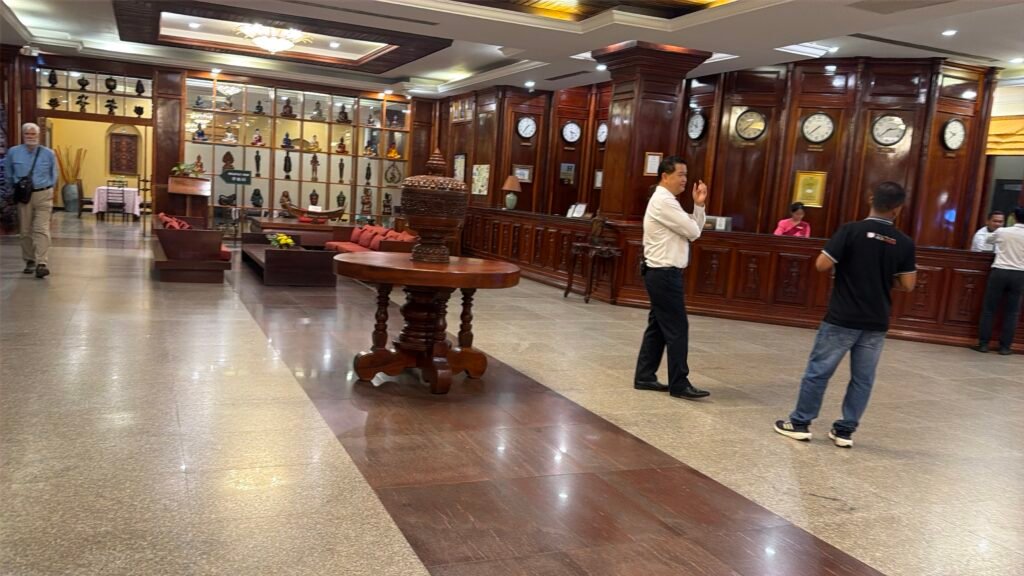
Our hotel’s lobby is quite beautiful and it is still decorated for Christmas. Christmas carols play over the sound system and Are said it will be like this for another month at least.

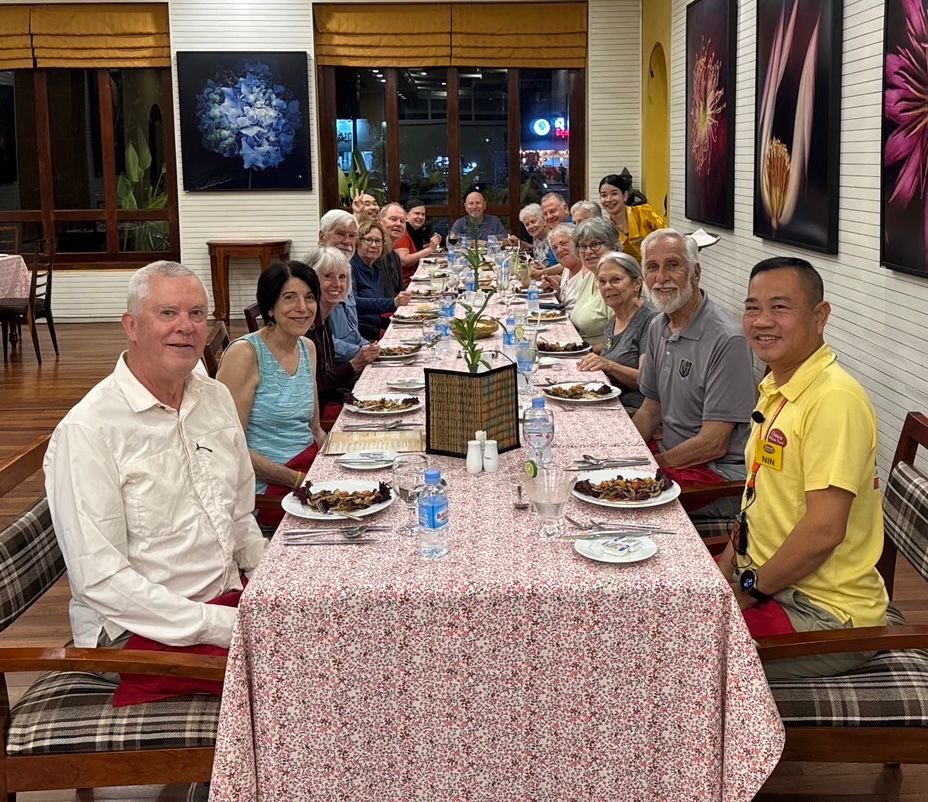
Allan and I decided to eat in the hotel and we met another couple from our group, Ann and Allan (spelled the same as my Allan), who had the same idea, and so we dined together and got to know each other. We were all looking forward to a cocktail or a glass of wine, only to be told that no alcoholic beverages could be purchased due to the upcoming election. The ban is in effect from 6:00 p.m. January 10 to 6 pm on January 11. Anyone who violates the ban is subject to imprisonment for up to six months, or a fine of up to 10,000 baht, or both.

While we were disappointed not to be able to enjoy a drink together, it was good to know we would be able to imbibe tomorrow night during the Welcome dinner. Still, even though sans wine, it was a great way to end the day – enjoying the company of new friends.

Tomorrow will be a busy day, so hoping to get a good night’s sleep. Melissa and John, who are in our group and who we had lunch with this afternoon, told us about the app TimeShifter which they said is very helpful to combat the effects of traveling to a different time zone. You begin to incorporate the recommendations a few days prior to embarking on your journey and they say it helps tremendously. Will check it out.

Phone in the airport. I bet most kids would have no clue how it works.

Chiang Mai. Flowers are blooming everywhere

The sites on our way to our hotel.

Part of the old wall that surrounded the city with the moat in front of it.

Queen Sirikit, the mother of Thailand’s King Vajiralongkorn, died a few months ago at the age of 93. For more than six decades, Queen Sirikit was married to Thailand’s longest-reigning monarch, King Bhumibol Adulyadej, who died in 2016. She is being honored all over Thailand. We saw black and white bunting on many buildings in Bangkok, but didn’t realize what they were for. Are explained this to us as we asked who was in the photo that was being honored in the hotel lobby.

In our hotel, Christmas is still being celebrated and will be probably for another month.

Finally … a delicious dark beer that we enjoyed with lunch.

One of the many temples in Chiang Mai. Our guide quipped that OAT, which of course stands for our tour company Overseas Adventure Travel, actually has a different meaning in Chiang Mai. It means
“Oh, Another Temple”. Too funny.

An artisan carving elephants out of teak wood.